Materials Research
Materials researchers use cold systems to see behavior that is hidden at higher temperatures. Superconductors, resonators, dielectrics, spin systems, and quantum materials can all reveal different physics when cooled and measured carefully.
For advanced readers, the key is measurement context: magnetic field, wiring, microwave loss, temperature stability, sample exchange, shielding, and calibration affect what a material result really means.
Quantum materials research uses low-temperature environments to study superconductors, resonators, dielectrics, spin systems, low-temperature transport, magnetic response, and device physics. These measurements matter because quantum hardware performance often depends on materials and interfaces rather than only circuit design.
QCRY includes materials research because many cryogenic tools used for quantum computing are also used to understand why devices lose coherence, generate noise, drift, or fail after fabrication.
Common low-temperature workflows
| Workflow | Cryogenic role |
|---|---|
| Superconducting resonator measurement | Measures loss, frequency shifts, two-level systems, and material quality at low power. |
| Transport measurement | Studies resistance, superconducting transitions, quantum Hall effects, and device behavior. |
| Magnetic-field experiments | Combines cryostats or dilution refrigerators with superconducting magnets. |
| Dielectric and interface studies | Connects fabrication choices to microwave loss and qubit performance. |
| Detector material testing | Evaluates films and devices used in SNSPDs, TES detectors, and sensors. |
Instrumentation needs
Materials labs may need cryostats, dilution refrigerators, magnets, low-noise wiring, microwave resonator testbeds, sample exchange, temperature sensors, vacuum systems, and low-vibration mounting. The exact stack depends on whether the measurement is microwave, DC transport, optical, magnetic, or mixed.
Why this affects quantum computing
Superconducting qubit coherence can be limited by dielectric loss, interfaces, quasiparticles, package modes, resonator loss, and fabrication defects. Cryogenic characterization helps link device performance to material choices before those choices are scaled into larger processors.
Related pages
- NIST Quantum Characterization
- What Is Quantum Cryogenics?
- Dilution Refrigerator
- Cryostats in Quantum Computing
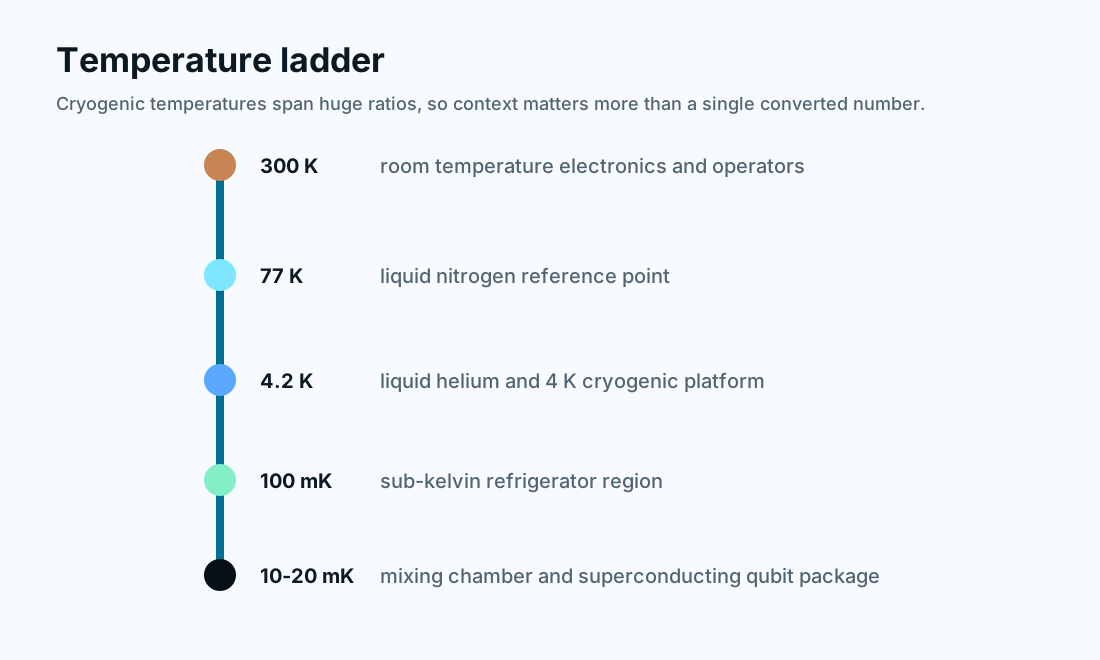
What the diagram shows
Research sources
- NIST Quantum Characterization: https://www.nist.gov/programs-projects/quantum-characterization
- Oxford Instruments quantum measurement: https://www.oxinst.com/applications/quantum-measurement
- NIST Technical Note 2335: https://nvlpubs.nist.gov/nistpubs/TechnicalNotes/NIST.TN.2335.pdf