Quantum Cryogenics Use Cases
Quantum cryogenics shows up anywhere a quantum device, detector, material, or low-noise measurement needs a colder and quieter environment than ordinary electronics can provide. The use case decides which parts of the cold stack matter most.
The advanced view compares needs: a qubit processor, an SNSPD, a SQUID sensor, a cryo-CMOS control chip, and a materials testbed can all need cryogenics for different reasons.
Quantum cryogenics is not one market. It is an enabling infrastructure layer across quantum computing, sensing, communication, detector technology, cryogenic electronics, and materials research. This page organizes use cases by hardware need rather than hype category.
Use-case matrix
| Use case | Cryogenic need | Typical components |
|---|---|---|
| Superconducting quantum computers | Millikelvin processor operation and microwave measurement | Dilution refrigerator, wiring, attenuators, filters, isolators, HEMTs, thermal anchors. |
| Quantum sensing | Low-noise superconducting sensors and precision measurement | Cryostats, SQUIDs, TES devices, SNSPDs, low-noise readout, magnetic shielding. |
| Cryogenic CMOS | Moving control or readout electronics closer to the device | 4 K or sub-kelvin electronics, power delivery, thermal budgeting, high-density wiring. |
| Single-photon detectors | Superconducting detector operation and optical/electrical packaging | SNSPD cryostats, optical fibers, detector packages, RF readout. |
| Quantum networking | Photon detection, memories, transduction, and timing | SNSPDs, cryogenic detector modules, optical interfaces, low-noise electronics. |
| Materials research | Low-temperature characterization of superconductors and quantum materials | Cryostats, dilution refrigerators, magnets, resonator testbeds, transport wiring. |
Why use cases matter
Searchers often arrive with an application in mind. A quantum networking reader may first care about SNSPDs, not dilution refrigerators. A materials researcher may care about cryostats, magnets, and microwave resonator measurement before they care about qubit packaging. A quantum-computing strategist may care about thermal load, wiring density, and supplier categories.
QCRY connects those entry points to the right cold stack.
Route into the site
- Start with Superconducting Quantum Computers if you want to understand millikelvin quantum processors.
- Start with Single-Photon Detectors if you care about quantum networking or photonic detection.
- Start with Cryogenic CMOS if you care about scale-up electronics.
- Start with Materials Research if you care about low-temperature characterization and superconducting materials.
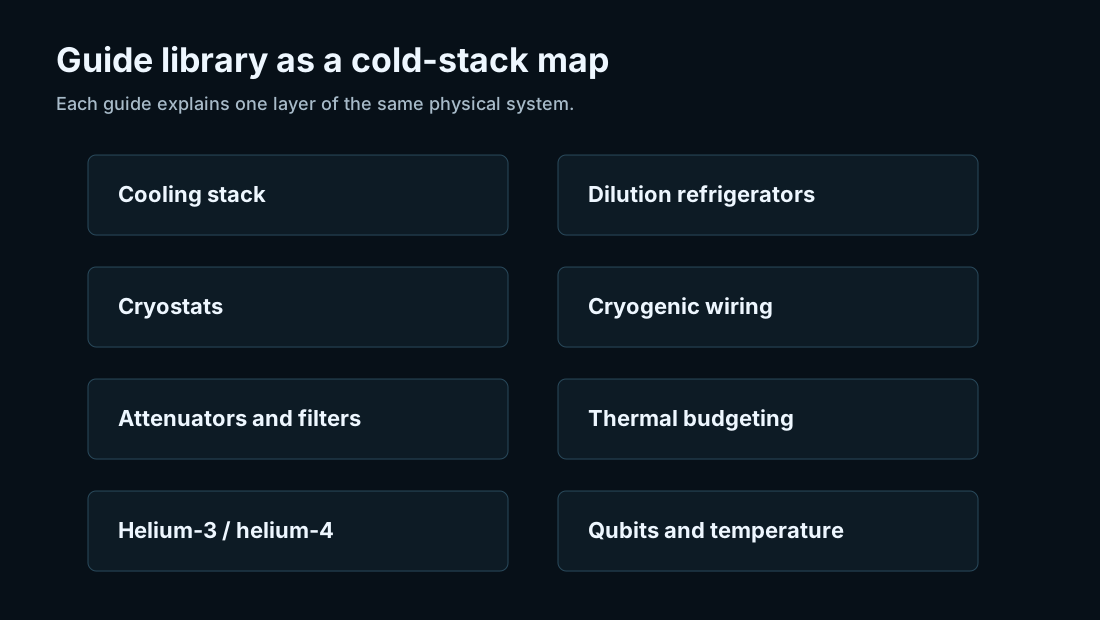
What the diagram shows
Research sources
- NIST Quantum Characterization: https://www.nist.gov/programs-projects/quantum-characterization
- NIST Quantum Sensors Division: https://www.nist.gov/pml/quantum-electromagnetics
- NIST single-photon detectors: https://www.nist.gov/pml/productsservices/quantum-networks-nist/technologies-quantum-networks/single-photon-detectors
- IBM Quantum Goldeneye: https://www.ibm.com/quantum/blog/goldeneye-cryogenic-concept-system