Quantum Cryogenics Research
The research library is for readers who want to see where the claims come from. It points toward papers, technical notes, standards work, and credible public sources that explain how cold quantum systems are actually built and measured.
The advanced use is source judgment: conditions, methods, stage definitions, measurement locations, vendor framing, and reproducibility matter as much as the headline result.
The research library tracks the technical sources behind the cold infrastructure of quantum technology. It is not trying to collect every paper. It is here to identify sources that explain how cryogenic systems actually perform: cooling stages, wiring, thermal budgets, microwave control, readout, detector packaging, cryogenic electronics, and measurement reproducibility.
Research categories
| Category | What QCRY looks for |
|---|---|
| Dilution refrigeration | Stages, cooling power, helium circulation, pulse-tube precooling, cooldown time, vibration, and loaded operation. |
| Superconducting qubit infrastructure | Microwave control lines, readout chains, attenuation, filters, isolators, amplifiers, packaging, and scaling constraints. |
| Cryogenic wiring | Cable heat loads, high-density interconnects, thermalization, connector reliability, and loss at cryogenic temperature. |
| Materials characterization | Superconducting resonator loss, two-level systems, quasiparticles, dielectric loss, and low-temperature metrology. |
| Detector cryogenics | SNSPDs, transition-edge sensors, optical coupling, readout, dark counts, timing jitter, and compact cryocoolers. |
| Cryogenic electronics | Cryo-CMOS, switches, MEMS RF components, multiplexing, power dissipation, and control architecture. |
Priority sources
- NIST Quantum Characterization: a program focused on reproducible measurement of superconducting microwave resonators at millikelvin temperatures and single-photon powers.
- NIST Technical Note 2335: useful context on RF cryogenic switch control, attenuation, gain, microwave quantum experiments, and low-temperature switching.
- Bluefors dilution refrigerator component explainers: accessible descriptions of staged refrigerator anatomy, pulse-tube precooling, shields, gas handling, and measurement infrastructure.
- IBM Goldeneye: a public example of cryogenic scale-up thinking around experimental volume, input/output ports, cooling power, vibration, and automation.
- EPJ Quantum Technology 100-qubit setup paper: a detailed source on attenuation placement, thermal noise photons, readout components, HEMT amplifiers, TWPAs, and passive heat-load measurement.
- NIST single-photon detector pages: practical descriptions of SNSPD operation, detector metrics, and cryogenic detector relevance.
How QCRY evaluates sources
QCRY prioritizes sources that state measurement conditions, temperature stages, power levels, frequency bands, component placement, and uncertainty. A claim about base temperature is more useful when the source also describes load, wiring, shields, cooldown, and instrumentation. A claim about a component is more useful when it includes cryogenic measurement rather than only room-temperature specifications.
Useful search vocabulary
- dilution refrigerator stages
- quantum computing cooling stack
- mixing chamber cooling power
- superconducting qubit microwave chain
- cryogenic RF attenuation
- cryogenic HEMT amplifier
- SNSPD cryogenic detector
- cryogenic CMOS quantum control
- cryogenic wiring thermal load
- millikelvin resonator measurement
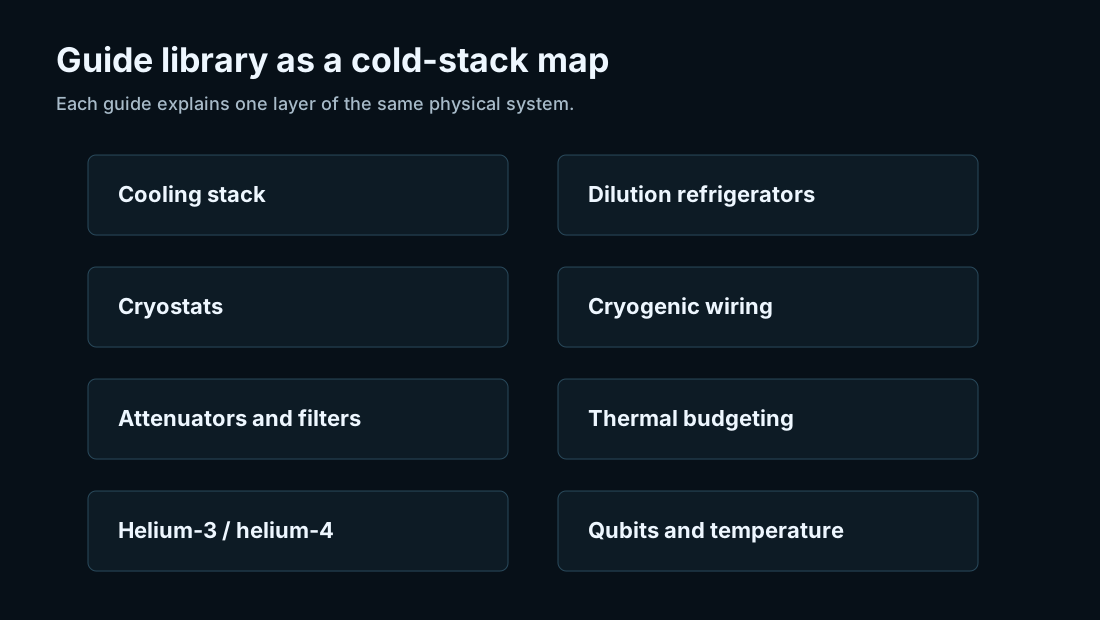
What the diagram shows
Source links
- NIST Quantum Characterization: https://www.nist.gov/programs-projects/quantum-characterization
- NIST Technical Note 2335: https://nvlpubs.nist.gov/nistpubs/TechnicalNotes/NIST.TN.2335.pdf
- NIST Big Quantum Chill: https://www.nist.gov/news-events/news/2024/04/big-quantum-chill-nist-scientists-modify-common-lab-refrigerator-cool
- Bluefors, dilution refrigerator components: https://bluefors.com/stories/components-of-the-dilution-refrigerator-measurement-system/
- Bluefors, measurement infrastructure: https://bluefors.com/stories/cryogenic-measurement-infrastructure-for-quantum-computing/
- IBM Goldeneye: https://www.ibm.com/quantum/blog/goldeneye-cryogenic-concept-system
- EPJ Quantum Technology 100-qubit-scale setup: https://link.springer.com/article/10.1140/epjqt/s40507-019-0072-0
- NIST single-photon detectors: https://www.nist.gov/pml/productsservices/quantum-networks-nist/technologies-quantum-networks/single-photon-detectors