Quantum Networking
Quantum networking depends on moving fragile quantum information between systems, often through photons. Cryogenics enters when the network needs superconducting detectors, transducers, memories, or low-noise measurement hardware.
The advanced questions are architectural: detector temperature, optical coupling, microwave-to-optical conversion, timing, dark counts, packaging, fiber access, and whether the platform is a lab instrument or deployable system.
Quantum networking connects quantum systems using photons, entanglement, single-photon sources, detectors, repeaters, memories, transducers, and classical coordination. Not every component in a quantum network is cryogenic, but cryogenics is central for several high-performance detector and device categories.
The most visible cryogenic role is photon detection. Superconducting nanowire single-photon detectors, or SNSPDs, are widely discussed for quantum communication and networking because they combine high efficiency, low dark counts, and excellent timing performance.
Where cryogenics enters
| Network function | Cryogenic relevance |
|---|---|
| Single-photon detection | SNSPDs and transition-edge sensors require low-temperature operation. |
| Quantum memories | Some candidate platforms need cryogenic environments or low-noise measurement. |
| Microwave-optical transduction | Interfaces between superconducting processors and optical photons can require cryogenic hardware. |
| Timing and readout | Low-noise electronics and stable detector packages affect system performance. |
| Materials and packaging | Optical coupling, fiber feedthroughs, and detector mounting become cryogenic design problems. |
Why SNSPDs matter
NIST describes SNSPDs as superconducting nanowires operated below 2.5 K, producing voltage pulses when a photon breaks local superconductivity. Detector metrics such as timing jitter, dark count rate, efficiency, and dead time directly affect network performance.
System design questions
- What cryogenic platform supports the detector count and uptime requirements?
- How are optical fibers routed and thermally anchored?
- What readout bandwidth and amplification are needed?
- How are detector modules serviced or replaced?
- Does the use case require field deployment, lab operation, or data-center-like infrastructure?
Related pages
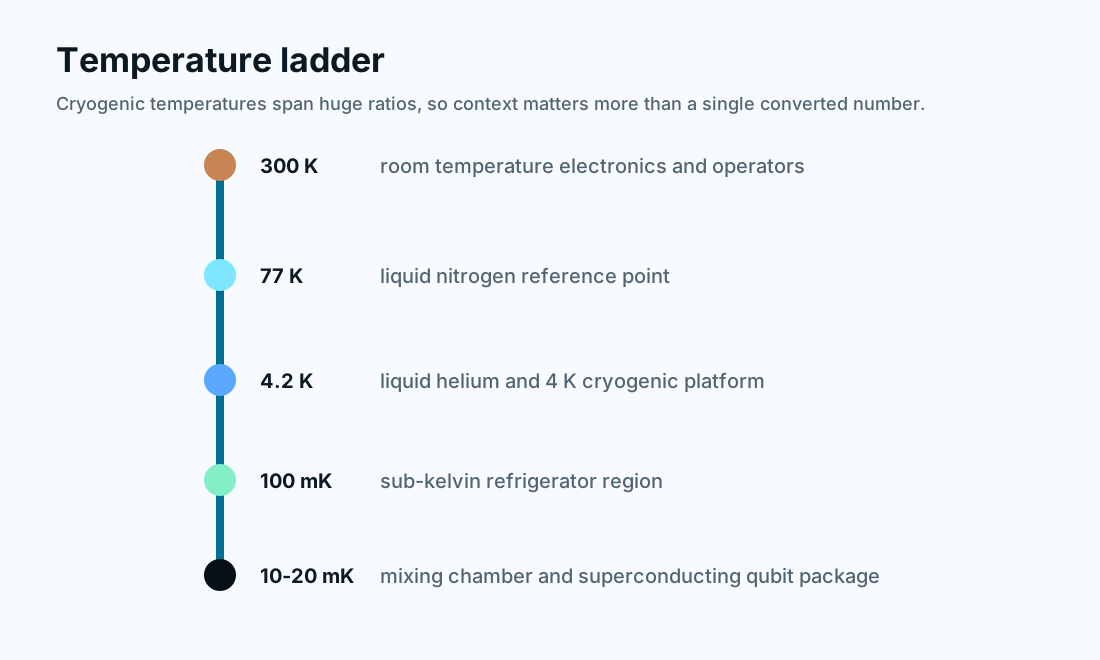
What the diagram shows
Research sources
- NIST single-photon detectors: https://www.nist.gov/pml/productsservices/quantum-networks-nist/technologies-quantum-networks/single-photon-detectors
- NIST single photonics and quantum information: https://www.nist.gov/programs-projects/single-photonics-and-quantum-information
- IBM quantum transduction research: https://research.ibm.com/projects/quantum-transduction-research