Cryostats in Quantum Computing
A cryostat is the protected cold environment around an experiment. It keeps heat, air, radiation, vibration, and stray noise away from hardware that only works under carefully controlled conditions.
For advanced readers, the useful question is not simply how cold it gets. It is what kind of access, shielding, wiring, optical path, magnet, sample space, and service routine the cryostat can support.
A cryostat is the insulated low-temperature environment that allows a quantum device, detector, material sample, or circuit to be cooled and measured. In everyday language, people sometimes use “cryostat,” “fridge,” and “dilution refrigerator” interchangeably, but the terms are not identical.
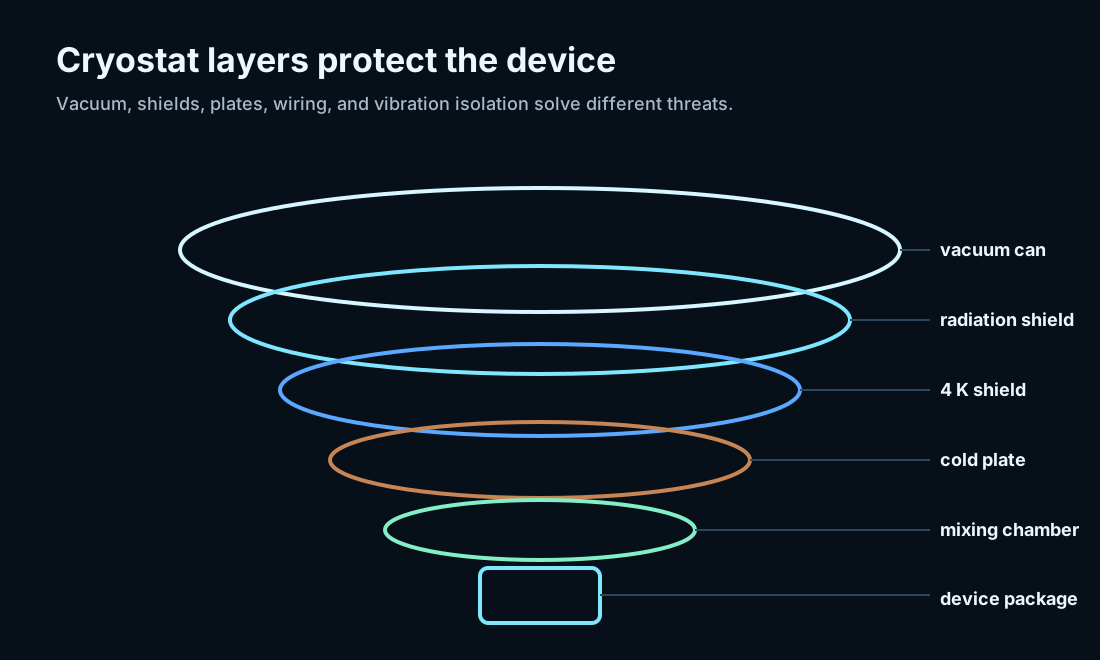
A dilution refrigerator is a particular cooling system. A cryostat is the broader physical environment: vacuum chamber, radiation shields, cold plates, mounts, feedthroughs, and thermal interfaces. Some cryostats reach only 4 K. Others integrate dilution refrigeration to reach millikelvin temperatures.
Why cryostats matter
Quantum experiments are sensitive to heat, vibration, electromagnetic interference, magnetic fields, and contamination. The cryostat is the boundary between a messy room-temperature lab and the carefully staged environment that quantum hardware needs.
In superconducting quantum computing, the cryostat must support microwave wiring and shielding. In quantum sensing, it may support a magnetic environment or low-vibration measurement. In photonic quantum systems, it may need optical fiber access. In materials research, it may need sample exchange, scanning probes, or strong magnetic fields.
Cryostat design elements
Key elements include:
- Vacuum space to reduce conductive and convective heat transfer.
- Radiation shields to reduce thermal radiation from warmer surfaces.
- Cold plates for mounting and thermalization.
- Feedthroughs for electrical, RF, DC, and optical connections.
- Mechanical supports designed to minimize heat leaks.
- Thermometry and heaters for monitoring and control.
- Magnetic shielding or magnets where required.
- Vibration isolation, especially when pulse tubes are used.
Common search questions
The key questions are:
- What is the difference between a cryostat and a refrigerator?
- How does a cryostat keep quantum hardware cold?
- Why does a quantum cryostat need vacuum?
- What components are inside a quantum cryostat?
- How do cables get into a cryostat without warming it up?
What the diagram shows
Research sources
- NIST cryocoolers overview: https://trc.nist.gov/cryogenics/cryocoolers.html
- Oxford Instruments quantum measurement: https://www.oxinst.com/applications/quantum-measurement
- Bluefors systems: https://bluefors.com/products/dilution-refrigerator-measurement-systems/