Single-Photon Detectors
A single-photon detector is built to notice one particle of light. For superconducting detector families such as SNSPDs, cryogenics is what keeps the detector material in the state where that single photon can be seen.
The expert view adds detector metrics: efficiency, dark counts, timing jitter, dead time, fiber coupling, readout bandwidth, operating temperature, and platform uptime.
Single-photon detectors are essential for quantum networking, quantum communication, photonic quantum computing, deep-space optical links, quantum sensing, and low-light scientific measurement. The most important cryogenic detector family for many of these applications is the superconducting nanowire single-photon detector, usually abbreviated SNSPD.
SNSPDs are cryogenic because the detecting element must remain superconducting. NIST describes SNSPDs as thin superconducting films patterned into a meandering nanowire, commonly coupled to optical-fiber output and typically operated below 2.5 K.
How an SNSPD works
An SNSPD is biased just below its critical current. When a photon is absorbed, a small local region of the superconducting nanowire becomes resistive. That event creates a voltage pulse that can be read by electronics. The detector then recovers and becomes ready for another photon.
The cryogenic system around the nanowire affects more than temperature. It also affects fiber coupling, electrical readout, timing jitter, dark counts, packaging, vibration, magnetic environment, and serviceability.
Key detector metrics
| Metric | Why it matters |
|---|---|
| Detection efficiency | Fraction of incoming photons that produce usable detection events. |
| Dark count rate | False events when no photon was present. |
| Timing jitter | Timing uncertainty of the detection pulse. |
| Dead time | Recovery time before another photon can be detected. |
| Operating temperature | Determines the required cryogenic platform and margin. |
| Fiber coupling | Affects system-level efficiency and packaging complexity. |
| Readout bandwidth | Determines whether pulses are preserved with useful timing. |
NIST lists SNSPD advantages including very low timing jitter, high detection efficiency, low dark count rates, and competitive dead times. Transition-edge sensors, or TES detectors, are another cryogenic photon detector family; they can resolve photon number but generally fit different speed and readout tradeoffs.
Cryogenic platforms
Not every cryogenic detector needs a large dilution refrigerator. Many SNSPD systems use compact cryocooler platforms or closed-cycle cryostats that reach the required low-temperature regime. The right platform depends on channel count, optical access, vibration, uptime, maintenance, and whether the detector is used in a lab experiment or a deployed communications system.
Why this matters here
For QCRY, single-photon detectors show that quantum cryogenics is larger than quantum computing. The same cold-engineering questions still appear:
- How is the device cooled and thermally anchored?
- How does the package bring optical and electrical signals in and out?
- What readout electronics preserve the signal?
- What supplier categories are involved?
- What specifications matter to buyers and researchers?
Related pages
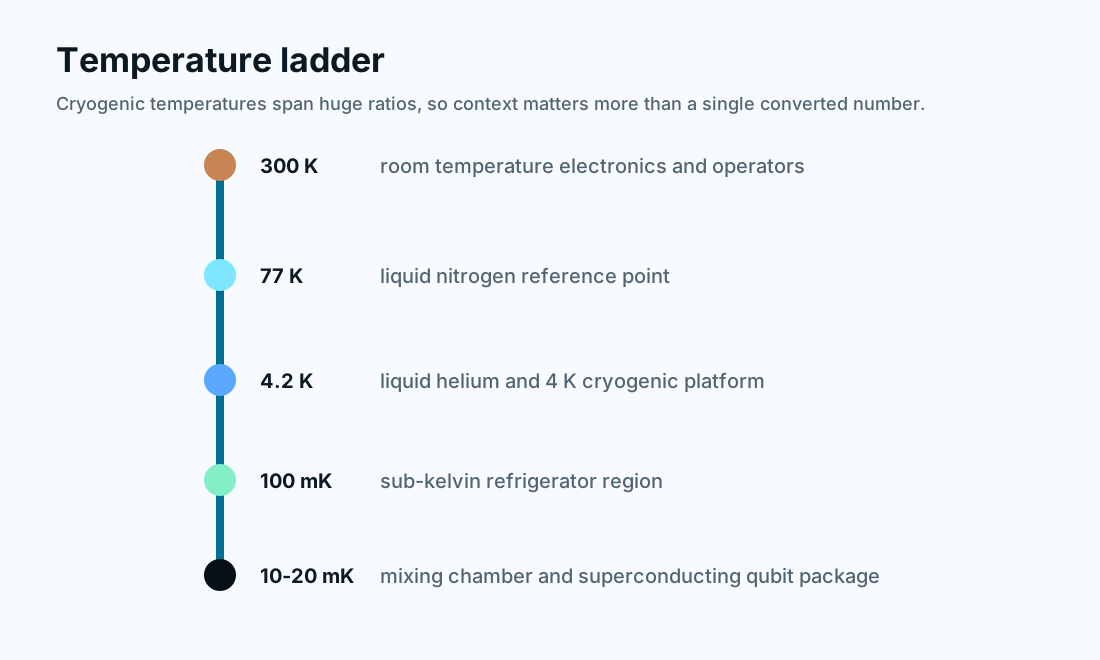
What the diagram shows
Research sources
- NIST single-photon detectors: https://www.nist.gov/pml/productsservices/quantum-networks-nist/technologies-quantum-networks/single-photon-detectors
- NIST SNSPD overview: https://www.nist.gov/noac/superconductive-nanowire-single-photon-detectors
- NIST Quantum Networks: https://www.nist.gov/pml/quantum-networks-nist