Superconducting Quantum Computers
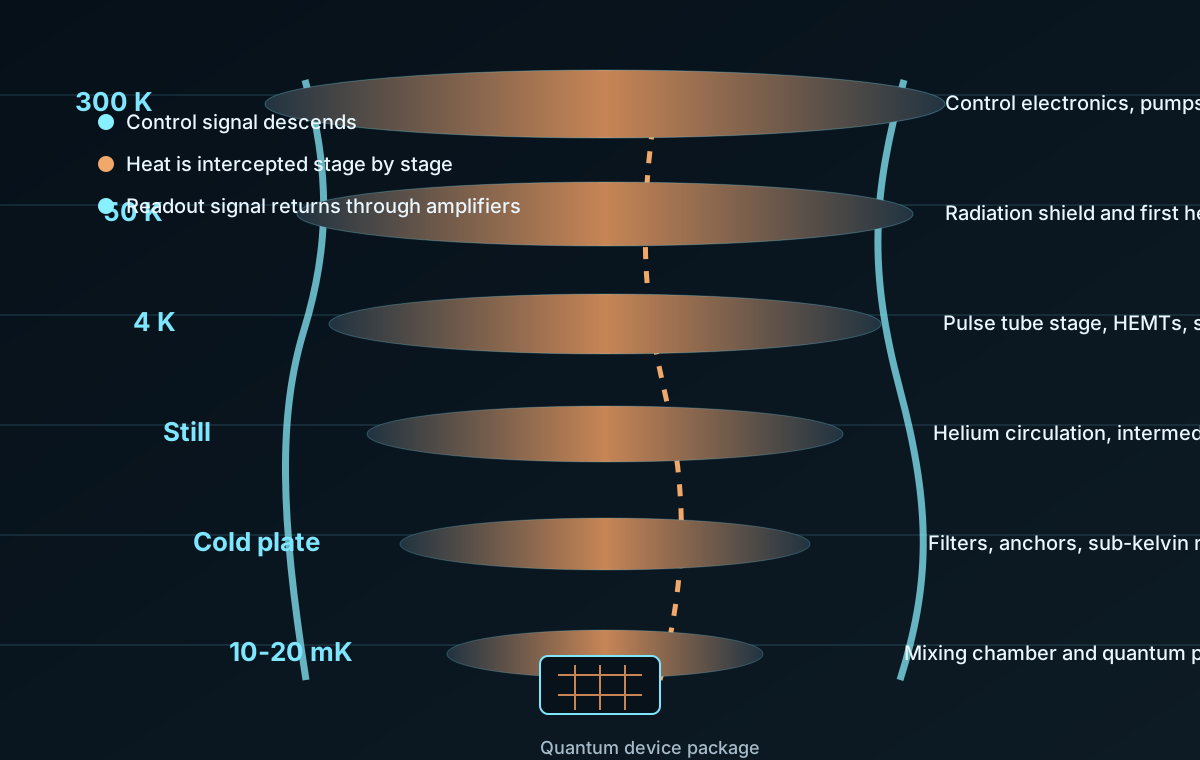
Superconducting quantum computers are the use case most people picture when they see the chandelier-like refrigerator. The chip is small, but the cold system around it is large because control and measurement must happen with very little thermal noise.
The advanced story is scaling: more qubits mean more lines, more heat, more packaging complexity, more readout pressure, and more demand for repeatable operation.
Superconducting quantum computers are the flagship use case for quantum cryogenics. Their processors are built from superconducting circuits and are commonly operated near the mixing chamber of a dilution refrigerator, where temperatures can reach the tens-of-millikelvin regime.
The cryogenic system is not a support accessory. It is part of the computer. It creates the low-temperature environment, routes microwave control signals, filters thermal noise, protects weak readout signals, and gives engineers a physical platform for packaging, shielding, calibration, and service.
Cold infrastructure
A superconducting quantum processor depends on:
- A dilution refrigerator and cryostat.
- Room-temperature control electronics and software.
- Microwave drive lines with distributed attenuation.
- Flux, bias, and DC control lines where required.
- Readout resonators and output lines.
- RF filters and infrared filters.
- Isolators, circulators, parametric amplifiers, and HEMT amplifiers.
- Thermal anchors, cold plates, shields, and sample mounts.
- A quantum processor package at or near the mixing chamber.
Why millikelvin operation matters
Superconducting qubits are microwave-frequency quantum circuits. At ordinary temperatures, thermal energy can populate microwave modes and disturb initialization, control, and readout. NIST technical work on cryogenic RF systems notes that microwave quantum experiments in the 4-8 GHz range can require temperatures below about 0.05 K to keep the quantum energy well above thermal energy.
In practice, this is why the processor package is often mounted near the mixing chamber, while higher stages handle cooling support, shielding, amplification, and wiring infrastructure.
Control and readout
Control lines carry microwave pulses from room-temperature instruments down to the qubit. They are attenuated and filtered across stages so the signal arrives with less thermal noise. Readout lines carry weak measurement signals back upward. They often use isolators and circulators near the cold stages, then cryogenic amplification before the signal returns to room temperature.
The result is a two-way microwave machine: strong, shaped control signals go down; fragile measurement signals come back up.
Scale-up bottlenecks
More qubits create cryogenic pressure in several places:
| Bottleneck | Why it matters |
|---|---|
| Wiring density | More channels require more feedthroughs, cables, connectors, anchors, and routing space. |
| Thermal load | Cables, attenuators, filters, amplifiers, and electronics consume stage cooling power. |
| Packaging | Larger chips and packages need signal fanout, shielding, grounding, and mechanical access. |
| Readout architecture | Amplifier capacity, multiplexing, and crosstalk become system-level constraints. |
| Operations | Cooldown time, diagnostics, repairability, and calibration affect real lab throughput. |
IBM’s Goldeneye cryogenic concept system illustrates this shift: large-scale quantum systems are increasingly described in terms of experimental volume, input/output ports, cooling power, vibration, and automation, not only base temperature.
What the cold stack adds
QCRY follows the cold infrastructure behind superconducting systems:
- Dilution refrigerator platforms.
- High-density wiring and measurement infrastructure.
- Cryogenic RF components.
- Thermal budgeting and cooling power.
- Readout amplification.
- Cryogenic control electronics.
- Supplier categories and benchmark vocabulary.
Related pages
- The Quantum Computing Cooling Stack
- Cryogenic Wiring for Quantum Computers
- Cryogenic Attenuators, Filters, and Isolators
- HEMT Amplifier
What the diagram shows
Research sources
- IBM Quantum, Goldeneye cryogenic concept system: https://www.ibm.com/quantum/blog/goldeneye-cryogenic-concept-system
- NIST Quantum Characterization: https://www.nist.gov/programs-projects/quantum-characterization
- NIST Technical Note 2335: https://nvlpubs.nist.gov/nistpubs/TechnicalNotes/NIST.TN.2335.pdf
- EPJ Quantum Technology, 100-qubit-scale cryogenic setup: https://link.springer.com/article/10.1140/epjqt/s40507-019-0072-0