Quantum Cryogenics Components
A quantum cryogenic system is made from ordinary-looking parts doing extraordinary jobs: plates, cables, filters, amplifiers, coolers, anchors, shields, and packages. The magic is not in one component; it is in how the whole stack works together.
The technical layer begins when you ask where each part sits, what temperature it reaches, how it is thermally anchored, how it affects signal quality, and what happens after repeated cooldowns.
Quantum cryogenics components are the physical parts that let quantum hardware stay cold, quiet, connected, and measurable. They include the refrigerator platform, temperature stages, wiring, filters, attenuators, amplifiers, thermal anchors, shields, sensors, vacuum systems, and control interfaces around the quantum device.
The component stack is best understood by location. A part mounted at room temperature solves a different problem than a part mounted at 4 K or the mixing chamber. The same word can also mean different things depending on whether the system supports superconducting qubits, single-photon detectors, cryogenic CMOS, quantum sensing, or low-temperature materials research.
Component map by function
| Function | Components | Why it matters |
|---|---|---|
| Cooling platform | Dilution refrigerator, cryostat, pulse tube cooler, gas handling system | Creates the staged low-temperature environment and controls cooldown, warmup, uptime, and serviceability. |
| Temperature stages | 50 K flange, 4 K flange, still, cold plate, mixing chamber | Give engineers physical mounting locations for shielding, wiring, filters, amplifiers, and the quantum package. |
| Signal delivery | Cryogenic coax, twisted pair, DC wiring, optical fiber, feedthroughs | Carries control, bias, readout, timing, and sensor signals while also conducting heat. |
| Noise control | Attenuators, RF filters, infrared filters, shielding, grounding | Reduces thermal photons, broadband noise, spurs, and electromagnetic leakage before they disturb the device. |
| Readout | Isolators, circulators, parametric amplifiers, HEMT amplifiers | Protects weak quantum signals and amplifies them early enough to preserve signal-to-noise ratio. |
| Thermal management | Thermal anchors, cold plates, clamps, heat switches, copper braids | Intercepts heat at the correct stages so the mixing chamber is not overloaded. |
| Measurement support | Temperature sensors, heaters, switches, magnets, sample mounts | Makes the cold system operable, measurable, and configurable for experiments. |
Core QCRY component pages
- Dilution Refrigerator: the millikelvin cooling platform used for many superconducting quantum devices.
- Pulse Tube Cooler: the cryogen-free precooling engine behind the 50 K and 4 K stages.
- Cold Plate: a physical thermal stage where components are mounted and thermalized.
- Mixing Chamber: the coldest stage and likely home of the quantum processor package.
- Cryogenic Cable: the wiring that carries signals while managing heat leak and microwave loss.
- HEMT Amplifier: a cryogenic low-noise amplifier used in readout chains.
- RF Filter: a device that suppresses unwanted frequency content in control and measurement lines.
- Thermal Anchor: the mechanical thermal contact that lets cables and parts dump heat into the right stage.
How to compare components
Supplier pages often list specifications without explaining how those specifications affect the full system. QCRY evaluates components by asking:
- What temperature stage is the component intended for?
- Does it add passive heat load, active power dissipation, or both?
- What signal bandwidth, insertion loss, impedance, noise, or gain does it affect?
- How is it thermalized mechanically?
- Does it need magnetic shielding, radiation shielding, grounding, or vibration isolation?
- How does it behave after repeated thermal cycles?
- What space, connector, and service-access constraints does it create?
- Which public specifications are measured, and under what conditions?
Stage-first selection logic
Start with the stage, then choose the part. A filter at room temperature, a filter at 4 K, and a filter at the mixing chamber may share a category name but solve different problems. A cable segment from room temperature to 4 K may prioritize low thermal conductivity; a cable segment from the mixing chamber to a first-stage amplifier may prioritize low microwave loss and superconducting materials.
The colder the stage, the more expensive each microwatt becomes. That is why component selection is not only a shopping exercise. It is a thermal budget, RF budget, packaging budget, and uptime budget at the same time.
Common component mistakes
- Choosing cable only by microwave loss and ignoring heat conduction.
- Reading a refrigerator base-temperature number without checking loaded cooling power.
- Treating an attenuator as a noise solution without accounting for dissipated power.
- Adding a filter without thinking through insertion loss, impedance matching, and thermal anchoring.
- Mounting components on a cold plate without enough contact area or repeatable clamp pressure.
- Assuming a vendor’s “quantum ready” phrase explains wiring, filters, amplifiers, sample space, and service model.
Related guides
- The Quantum Computing Cooling Stack
- Cryogenic Wiring for Quantum Computers
- Cryogenic Attenuators, Filters, and Isolators
- Cryogenic Thermal Budgeting
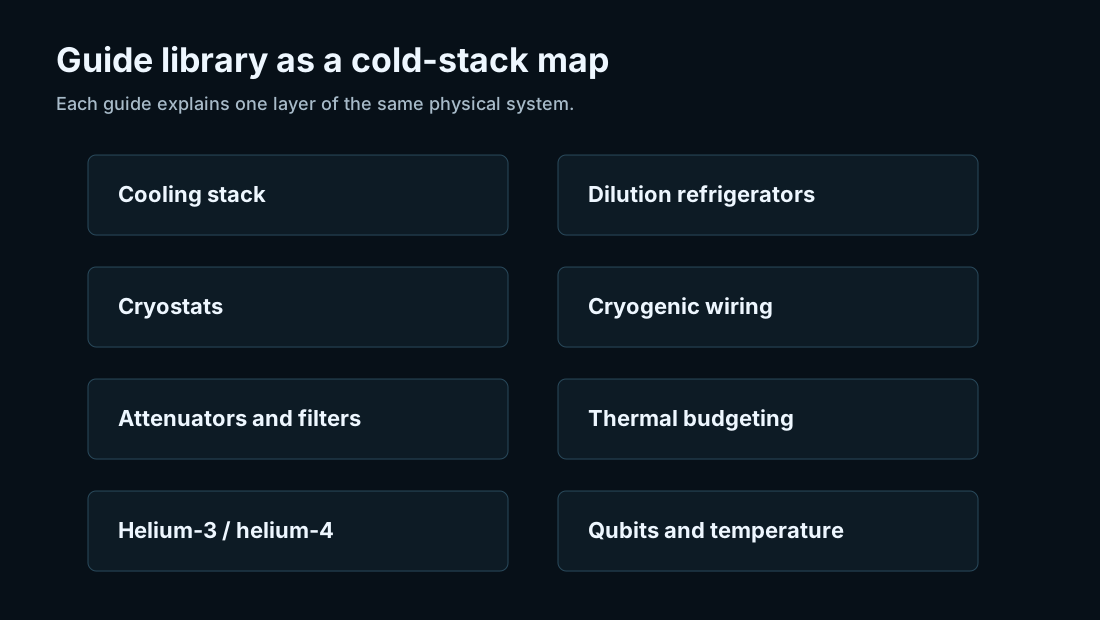
What the diagram shows
Research sources
- Bluefors, “Components of the Dilution Refrigerator Measurement System”: https://bluefors.com/stories/components-of-the-dilution-refrigerator-measurement-system/
- Bluefors, “Cryogenic Measurement Infrastructure for Quantum Computing”: https://bluefors.com/stories/cryogenic-measurement-infrastructure-for-quantum-computing/
- NIST, “Quantum Characterization”: https://www.nist.gov/programs-projects/quantum-characterization
- NIST Technical Note 2335: https://nvlpubs.nist.gov/nistpubs/TechnicalNotes/NIST.TN.2335.pdf