Quantum Cryogenics Market Map
Quantum cryogenics looks like one market from far away. Up close, it is a stack of connected markets. A lab may buy a dilution refrigerator from one company, cryogenic cables from another, filters and attenuators from another, amplifiers from another, control hardware from another, and integration help from yet another.
This page helps you read that landscape without getting lost in supplier vocabulary. Start with the cold platform, then follow the signals down to the device and back up through the readout chain. The market begins to make sense when every company is tied to a job inside that system.
Use the map this way:
- If you are new to the field, scan the layers below to understand what each supplier category does.
- If you are comparing vendors, use the category table to separate full platforms from parts, services, and end-use systems.
- If you are researching the market, treat this page as the bridge between the Supplier Directory, the component guides, and the benchmarks.
The market in one view
| Layer | What it solves | Typical buyers | Example supplier types |
|---|---|---|---|
| Cold platforms | Creates the low-temperature environment for quantum devices and detectors. | Quantum labs, national labs, startups, device-screening teams, materials groups. | Dilution refrigerator builders, cryostat vendors, compact detector cryocooler makers. |
| Cold generation | Provides the mechanical cooling and helium infrastructure behind the platform. | Cryostat builders, facilities teams, large research programs. | Pulse-tube cooler suppliers, compressors, helium recovery, gas handling, helium circulation. |
| Wiring and interconnect | Carries control, bias, sensor, pump, and readout signals between room temperature and the cold device. | Quantum computing teams, spin-qubit labs, sensing labs, integration partners. | Cryogenic coax suppliers, high-density flex interconnects, DC wiring, feedthroughs, thermalization hardware. |
| RF and microwave chain | Reduces noise, shapes signals, protects devices, and amplifies weak readout. | Superconducting-qubit teams, detector teams, microwave engineers. | Attenuator, filter, isolator, circulator, termination, HEMT, and parametric-amplifier suppliers. |
| Thermal and mechanical hardware | Moves heat where it belongs and keeps the installed system physically stable. | Cryogenic engineers, lab operators, instrument builders. | Cold plates, thermal anchors, clamps, shields, heat switches, copper braid, vibration-control parts. |
| Sensors and metrology | Measures temperature, magnetic field, device response, noise, and calibration state. | Labs, metrology groups, detector teams, quality teams. | Temperature sensors, controllers, SQUID systems, calibration hardware, resonator and probe systems. |
| Control and readout electronics | Generates and captures the signals that operate the quantum device. | Quantum computing teams, device-screening groups, control-stack teams. | AWG, digitizer, microwave control, timing, synchronization, and orchestration systems. |
| Services and integration | Turns parts into a working installed system. | New quantum labs, scaling teams, universities, enterprise R&D groups. | Installation, maintenance, custom wiring, lab buildout, benchmarking, repair, integration, training. |
| End markets | Pull demand through the cold stack. | Hardware companies, labs, telecom groups, sensing companies, research institutions. | Superconducting quantum computing, spin qubits, quantum sensing, quantum networking, SNSPDs, materials research. |
How the categories fit together
A working quantum cryogenic system is not just a cold box. It is a controlled environment with power, signals, shielding, mechanical stability, thermal margin, and operations wrapped around a fragile device.
The platform supplier defines the physical envelope. Wiring and interconnect suppliers determine how many useful signals can reach the device. RF and microwave suppliers determine how clean those signals are. Amplifier and detector suppliers determine whether weak outputs can be measured. Control-electronics suppliers determine how the experiment is driven. Integration and service companies determine whether the installed system keeps working after the first cooldown.
That is why the most important market question is not simply, “Who sells dilution refrigerators?” A better question is, “Which part of the cold stack is limiting the next system?”
Where demand comes from
| Use case | What usually matters first | Market pressure created |
|---|---|---|
| Superconducting quantum computing | Millikelvin cooling, microwave control, dense wiring, filtering, readout amplification, uptime. | Larger refrigerators, denser interconnects, better RF hygiene, faster service, more automation. |
| Spin qubits | Low temperature, magnetic-field compatibility, DC wiring, microwave control, device screening. | Flexible test systems, low-noise wiring, magnetic-environment options, high-throughput characterization. |
| Quantum sensing | Noise control, shielding, detectors, calibration, field compatibility, packaging. | Specialized cryostats, low-noise electronics, sensors, metrology tools, application-specific integration. |
| Quantum networking | Single-photon detection, timing, optical access, cryogenic detector packages. | SNSPD systems, compact cryocoolers, optical feedthroughs, detector readout, deployed-system support. |
| Materials research | Variable temperature, magnets, probes, resonators, sample exchange. | Research cryostats, probe stations, sensors, microwave test infrastructure, custom services. |
What changes as systems scale
Early research systems often optimize for flexibility. A team needs access, quick iteration, many experiment types, and enough performance to learn. Larger quantum programs optimize for repeatability, uptime, density, serviceability, and known margins.
Scaling changes the buyer conversation:
- A low base temperature matters less than loaded performance with real wiring installed.
- Line count matters only when the heat, space, and service model still work.
- More integrated systems can save time, but they can also hide assumptions.
- Cryogenic electronics can reduce wiring burden, but their heat has to be justified.
- Supplier support becomes part of system performance because downtime is expensive.
How to compare companies
When you look at a supplier, place it in the stack before judging it. A refrigerator company, a cable company, a microwave component company, and a control-electronics company may all describe themselves as quantum infrastructure companies. They are not interchangeable.
Good comparison questions:
- What temperature stages does the product touch?
- Does it support superconducting qubits, spin qubits, detectors, sensing, materials research, or several of those?
- Is it a full platform, a subsystem, a component, a control layer, or a service?
- Are the published specifications measured in realistic installed conditions?
- What part of the system becomes easier if this product works well?
- What new heat, noise, space, calibration, or maintenance burden does it add?
Representative supplier categories
The QCRY Supplier Directory is the best place to search individual companies. At the market-map level, it helps to think in clusters:
- Platform suppliers: companies focused on dilution refrigerators, cryostats, compact detector systems, and full low-temperature environments.
- Measurement-infrastructure suppliers: companies selling wiring, feedthroughs, thermal anchoring, filtering, and installed signal paths.
- RF and microwave suppliers: companies supplying attenuators, filters, isolators, circulators, HEMTs, parametric amplifiers, and microwave packaging.
- Metrology and sensor suppliers: companies focused on thermometry, magnetic measurement, SQUIDs, controllers, probe systems, calibration, and test equipment.
- Control-stack suppliers: companies selling room-temperature or cryogenic electronics for pulse generation, digitization, timing, synchronization, and orchestration.
- Integration and service suppliers: companies that install, maintain, wire, customize, benchmark, and support cold quantum systems.
Market signals worth watching
The strongest market signals are usually not the flashiest quantum announcements. Watch for changes that affect the physical stack:
- Larger loaded cooling-power claims.
- New high-density wiring approaches.
- Shorter cooldown and sample-exchange workflows.
- Lower-loss readout chains before first amplification.
- Cryo-CMOS and cryogenic switching that reduce cable count.
- Service models built around uptime rather than one-time installation.
- Detector packages moving from laboratory instruments toward deployed systems.
- Public benchmarks that describe configuration, load, and measurement conditions clearly.
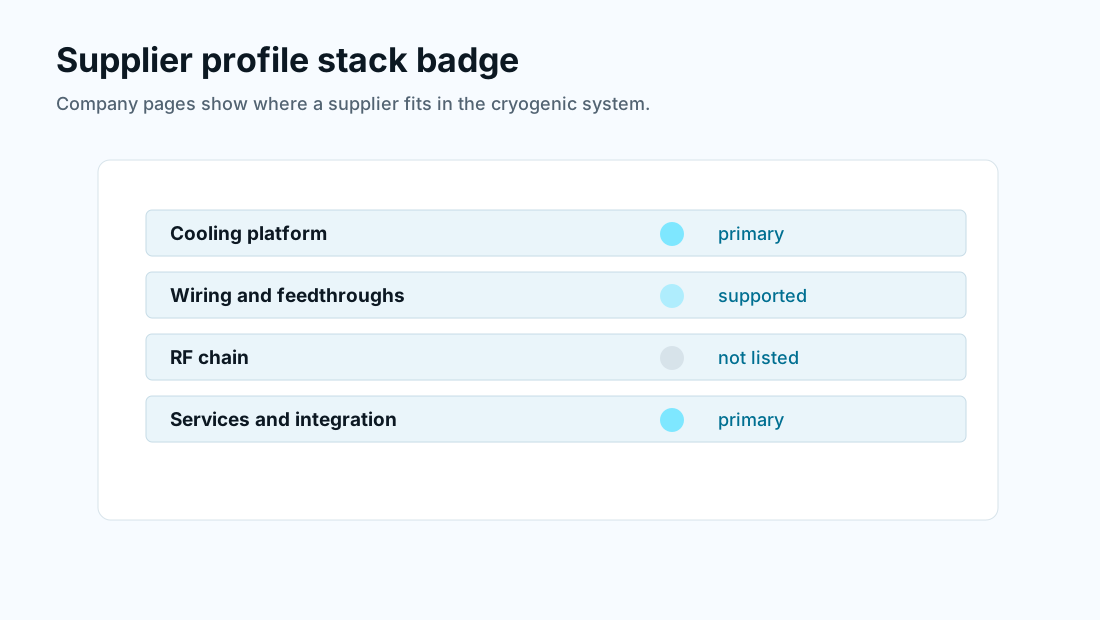
What the diagram shows
Go deeper
- Search the Supplier Directory
- Compare cold-stack terminology
- Review component categories
- Read benchmark criteria
- Learn how supplier profiles work
Research sources
- Bluefors measurement infrastructure: https://bluefors.com/stories/cryogenic-measurement-infrastructure-for-quantum-computing/
- IBM Goldeneye: https://www.ibm.com/quantum/blog/goldeneye-cryogenic-concept-system
- NIST Quantum Characterization: https://www.nist.gov/programs-projects/quantum-characterization
- NIST single-photon detectors: https://www.nist.gov/pml/productsservices/quantum-networks-nist/technologies-quantum-networks/single-photon-detectors