Quantum Sensing
Quantum sensing is about measuring tiny signals that ordinary instruments can miss. Some sensors work at room temperature, but superconducting sensors and ultra-low-noise detectors often need cryogenic platforms to reach their best performance.
The advanced layer is system noise: temperature, shielding, vibration, readout electronics, calibration, and packaging can decide whether the sensor performs like the physics says it should.
Quantum sensing uses quantum systems to measure physical quantities with high sensitivity. Some quantum sensors operate at room temperature, but many superconducting sensors, low-temperature detectors, and precision measurement systems depend on cryogenic infrastructure.
QCRY covers quantum sensing because sensing is one of the clearest examples of cold hardware becoming useful outside the narrow story of quantum computing. The same cryogenic questions appear: temperature, noise, shielding, readout, packaging, and reliability.
Cryogenic sensing examples
| Sensor or detector | Cryogenic relevance |
|---|---|
| SQUIDs | Superconducting quantum interference devices for sensitive magnetic measurement. |
| Transition-edge sensors | Superconducting devices operated near a transition temperature for photon or particle detection. |
| SNSPDs | Superconducting nanowire single-photon detectors used in communication, networking, sensing, and research. |
| Cryogenic microwave sensors | Low-noise microwave measurement devices for quantum and materials experiments. |
| Low-temperature thermometers | Temperature sensors needed to operate and calibrate cryogenic systems. |
What the cryogenic system must provide
Quantum sensing systems may need a stable low-temperature platform, low vibration, magnetic shielding, optical or microwave access, low-noise readout, and reproducible calibration. A sensor can be excellent in principle but weak in practice if the package, wiring, shielding, or readout chain adds noise.
Why this matters commercially
Quantum sensing may produce near-term value in measurement, imaging, timing, magnetic-field detection, and scientific instrumentation. That makes cryogenic sensing a useful market segment for suppliers of cryostats, detectors, low-noise electronics, and integration services.
Related pages
- Single-Photon Detectors
- Quantum Networking
- Cryostats in Quantum Computing
- Quantum Cryogenics Supplier Directory
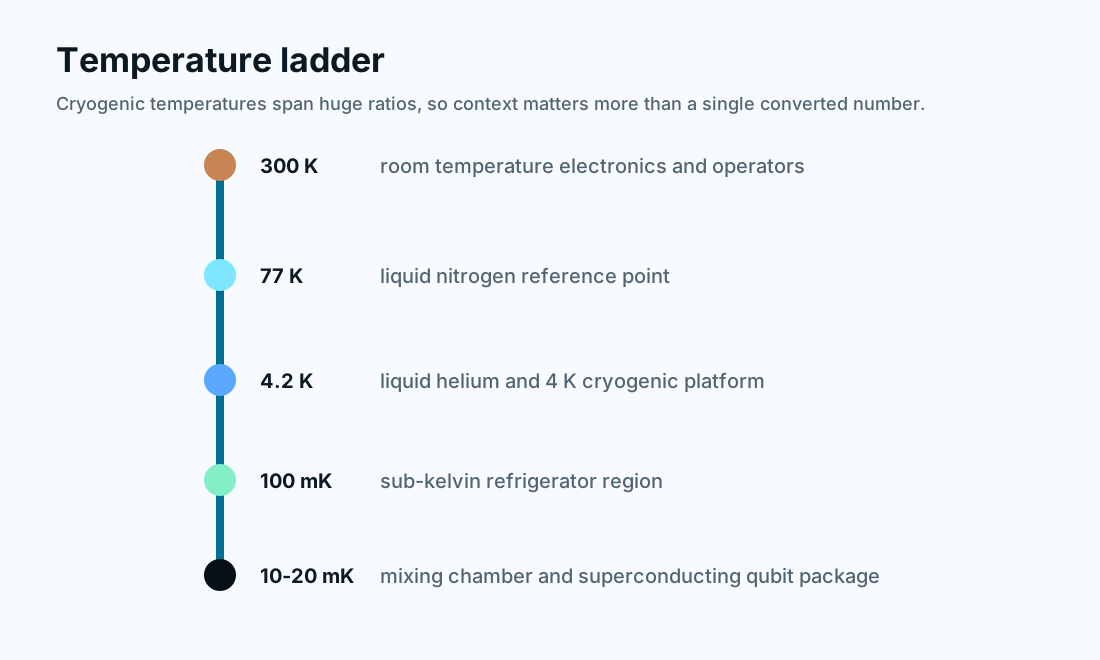
What the diagram shows
Research sources
- NIST Quantum Sensors Division: https://www.nist.gov/pml/quantum-electromagnetics
- NIST magnetic quantum sensing explainer: https://www.nist.gov/quantum-information-science/quantum-sensing-explained/sensors-magnetic-world
- NIST single-photon detectors: https://www.nist.gov/pml/productsservices/quantum-networks-nist/technologies-quantum-networks/single-photon-detectors