Dilution Refrigerator
A dilution refrigerator is the cold platform under many superconducting quantum computers. It creates the millikelvin environment, but it also has to carry the wiring, shields, amplifiers, sensors, and sample hardware that make the experiment usable.
The advanced view treats it as an integration platform: cooling power, stage geometry, wiring capacity, vibration, automation, sample access, and loaded operating temperature all matter together.
A dilution refrigerator is the millikelvin cooling platform used by many superconducting quantum computers and low-temperature quantum experiments. It uses a helium-3 and helium-4 mixture to provide continuous cooling at temperatures far below 1 K, often reaching the tens-of-millikelvin regime at the mixing chamber.
For quantum computing, the dilution refrigerator is not only a cold box. It is an integration platform for wiring, filters, attenuators, amplifiers, sample packages, shields, sensors, gas handling, software, and service access.
Stages and physical structure
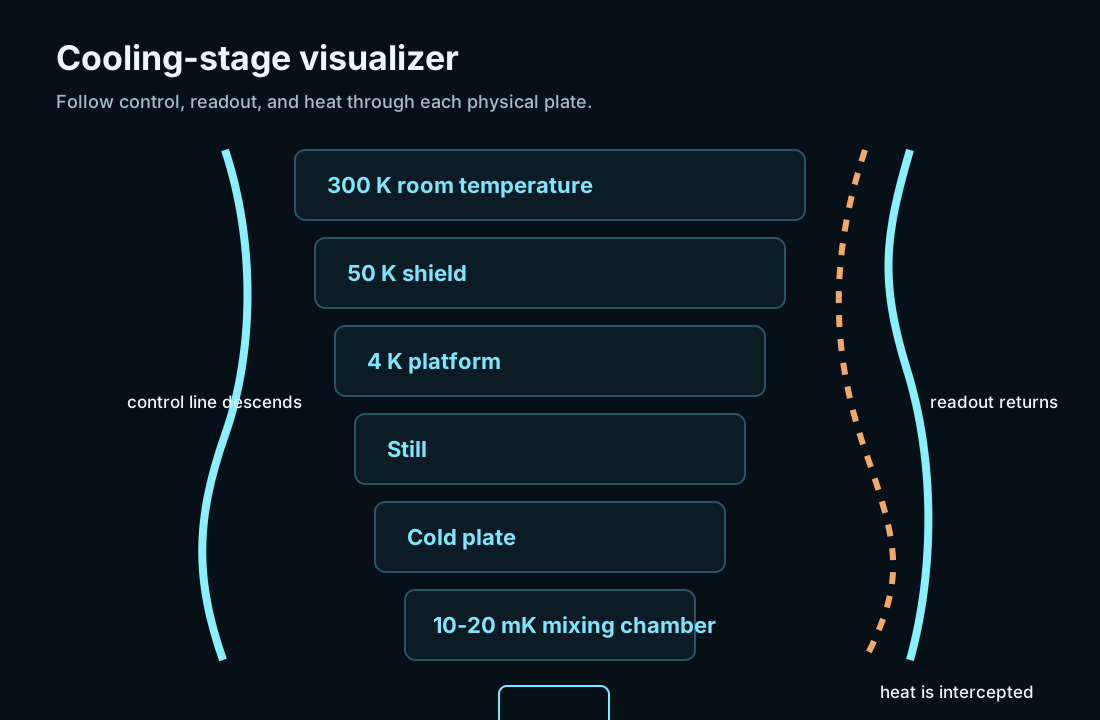
A typical cryogen-free dilution refrigerator includes room-temperature infrastructure, a vacuum can, radiation shields, 50 K and 4 K flanges, the still, the cold plate, and the mixing chamber. Bluefors describes the common stage sequence as room temperature, about 40 K, about 3 K, still flange, cold plate, and mixing chamber flange, with the 50 K and 4 K names functioning as hardware conventions.
Key specifications
| Specification | Why it matters |
|---|---|
| Base temperature | Indicates the lowest achievable temperature under defined conditions. |
| Loaded mixing-chamber temperature | More useful than empty base temperature for real systems. |
| Cooling power at 20 mK and 100 mK | Determines available margin for chip packages, wiring, filters, and cold electronics. |
| 4 K cooling power | Supports shields, amplifiers, switches, and higher-stage wiring. |
| Cooldown and warmup time | Affects lab throughput and hardware iteration speed. |
| Experimental volume | Determines package size, line routing, and future expansion. |
| Wiring capacity | Limits control, readout, bias, pump, and sensor channels. |
| Vibration and acoustic isolation | Affects sensitive measurement and package stability. |
| Automation and diagnostics | Determines operational reliability and staffing burden. |
Integration concerns
The loaded refrigerator is what matters. A system may reach a very low base temperature before cables and components are installed, then operate warmer once a realistic quantum stack is added. Buyers should ask which wiring, filters, amplifiers, and package assumptions are included in a specification.
Common failure modes
Leaks, poor vacuum, poor thermal contact, excess vibration, insufficient line thermalization, limited cooling power, gas-handling faults, connector failures, and service complexity can all turn a strong refrigerator specification into a weak operating platform.
Related pages
What the diagram shows
Research sources
- Bluefors dilution refrigerator components: https://bluefors.com/stories/components-of-the-dilution-refrigerator-measurement-system/
- IBM Goldeneye: https://www.ibm.com/quantum/blog/goldeneye-cryogenic-concept-system
- NIST Big Quantum Chill: https://www.nist.gov/news-events/news/2024/04/big-quantum-chill-nist-scientists-modify-common-lab-refrigerator-cool