What Is Quantum Cryogenics?
Quantum cryogenics is the work of making a quantum device cold enough, quiet enough, and connected enough to behave quantum mechanically. Cold alone is not enough; the device still needs signals, power, measurement, shielding, and people who can service the system.
After that basic idea, the details matter quickly: millikelvin stages, helium mixtures, thermal noise, microwave lines, thermal anchors, cooling power, and the difference between an empty refrigerator specification and a loaded operating machine.
Quantum cryogenics is the engineering discipline that creates and manages extremely cold environments for quantum devices. In quantum computing, the phrase most often refers to the cryogenic systems used for superconducting qubits, cryogenic electronics, quantum sensors, and superconducting photon detectors.
The field combines thermodynamics, vacuum engineering, microwave engineering, materials science, RF packaging, low-noise electronics, helium gas handling, temperature measurement, vibration control, and system integration. It is not just “making things cold.” It is the art of keeping the right things cold while still connecting them to power, signals, control electronics, optical fibers, measurement instruments, and human operators.
Why cold matters
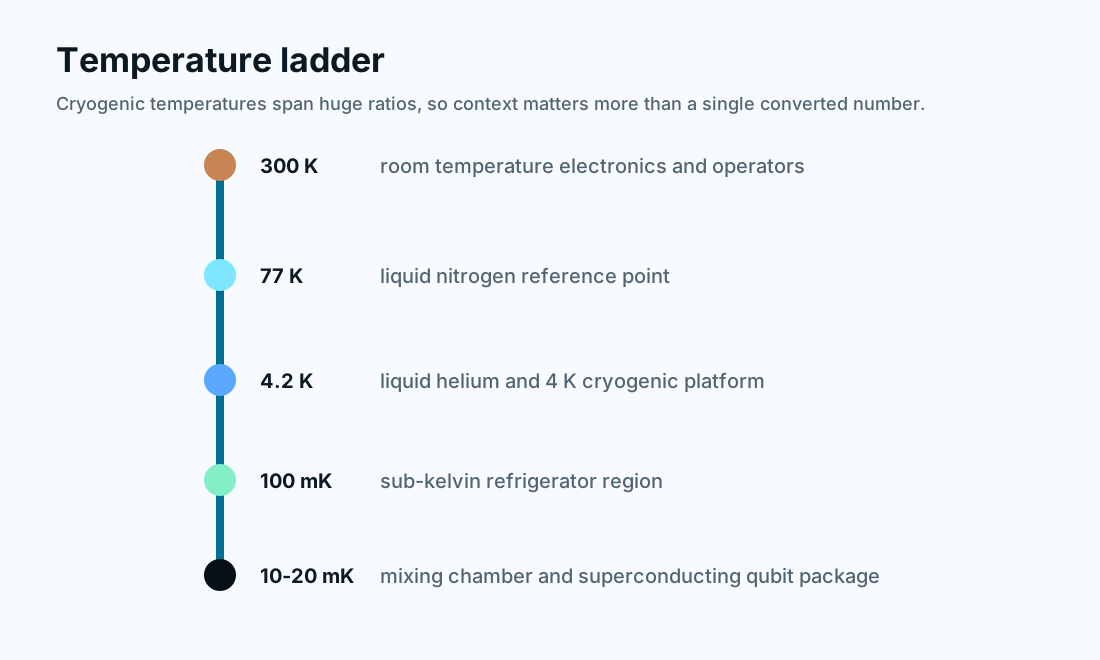
Quantum states are fragile. Thermal energy, electromagnetic noise, vibration, stray infrared radiation, poor grounding, and poorly thermalized wiring can all degrade a measurement. Many superconducting quantum processors are cooled to roughly 10 to 20 millikelvin, only a small fraction of one kelvin above absolute zero. At these temperatures, the device can behave as a controllable quantum circuit instead of a noisy warm object.
The popular image of a quantum computer often shows a chandelier-like gold structure. That structure is not the computer itself. It is the staged thermal and wiring environment around the chip. The processor sits near the coldest stage, while cables, filters, attenuators, amplifiers, shields, and plates connect it to the outside world.
The cryogenic stack in plain English
A typical superconducting quantum setup includes:
- A cryostat, which provides the insulated vacuum environment.
- A pulse tube or other cryocooler that removes heat from higher-temperature stages.
- A dilution refrigerator that uses a helium-3 and helium-4 mixture to reach millikelvin temperatures.
- Temperature stages such as 50 K, 4 K, still, cold plate, and mixing chamber.
- Wiring and microwave components that bring control signals down and readout signals back up.
- Filters and attenuators that reduce thermal photons and unwanted noise.
- Cryogenic amplifiers that boost tiny readout signals with as little added noise as possible.
- Thermal anchors that tie cables and components to the correct stage.
What makes quantum cryogenics hard
Every connection into a cryostat is a tradeoff. A wire carries a signal, but it also carries heat. An attenuator reduces noise, but dissipates power. A stronger amplifier improves readout, but adds heat and noise. More qubits require more control and readout channels, but the refrigerator has limited cooling power and physical space.
This is why cryogenic engineering has become central to scaling quantum computing. The limiting question is not only “Can we make better qubits?” It is also “Can we package, wire, cool, control, and measure many qubits at once?”
What the diagram shows
Common questions
- Is space cold enough for a quantum computer? No. Space can be cold, but a quantum processor needs a controlled low-noise environment, not just a low average temperature.
- Why do quantum computers look like chandeliers? The visible structure is the staged refrigerator, shields, plates, and wiring around the processor.
- Do all quantum computers need cryogenics? No. Superconducting systems do, many detectors do, and some sensors do. Other modalities use different environmental controls.
- What is the difference between a cryostat and a dilution refrigerator? A cryostat is the insulated low-temperature environment; a dilution refrigerator is a specific cooling system that can reach millikelvin temperatures.
Research sources
- NIST cryocoolers overview: https://trc.nist.gov/cryogenics/cryocoolers.html
- NIST Quantum Characterization: https://www.nist.gov/programs-projects/quantum-characterization
- Bluefors dilution refrigerator systems: https://bluefors.com/products/dilution-refrigerator-measurement-systems/
- Oxford Instruments quantum measurement: https://www.oxinst.com/applications/quantum-measurement