Cryogenic CMOS
Cryo-CMOS tries to move some classical control or readout electronics closer to the quantum device. The attraction is shorter wiring and tighter integration; the danger is adding heat and noise where the system can least afford it.
The advanced layer is a trade space: operating temperature, power dissipation, multiplexing, reliability, interconnect density, timing, packaging, and compatibility with the quantum device all have to be balanced.
Cryogenic CMOS, often called cryo-CMOS, is the effort to operate classical control, multiplexing, switching, and readout electronics at low temperatures near quantum devices. The promise is to reduce wiring complexity and improve integration. The challenge is heat, noise, reliability, and compatibility with fragile quantum systems.
Cryo-CMOS is attractive because wiring does not scale gently. If every qubit or resonator requires multiple room-temperature lines, the cryostat becomes crowded with cables, connectors, heat loads, and calibration complexity.
What cryo-CMOS might do
| Function | Potential benefit | Cryogenic tradeoff |
|---|---|---|
| Multiplexing | Reduces number of physical lines crossing stages | Adds active electronics and control complexity. |
| Signal generation | Moves control closer to the chip | Dissipates power near cold stages. |
| Readout processing | Reduces data movement and wiring burden | Adds heat and possible noise near sensitive measurements. |
| Switching | Enables configurable routing and calibration | Switch loss, dissipation, and reliability matter. |
The thermal bargain
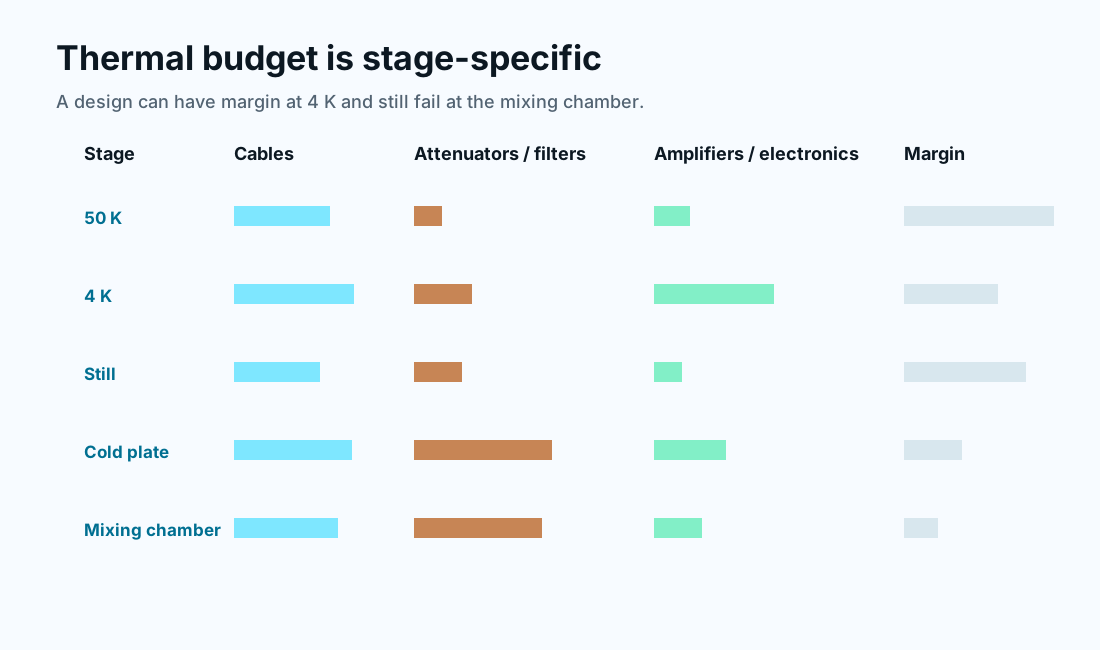
Cryo-CMOS has to earn its heat. A block of electronics at 4 K or below may be worthwhile if it removes enough wiring burden, improves latency, enables multiplexing, or simplifies packaging. It is not worthwhile if its dissipated power consumes more cooling margin than it saves.
This makes cryo-CMOS a thermal-budget topic as much as an electronics topic.
Integration questions
- At what temperature does the circuit operate?
- How much power does it dissipate under realistic duty cycle?
- Which room-temperature cables does it eliminate?
- How does it affect microwave noise and readout fidelity?
- Can it survive repeated thermal cycles?
- How is it tested, calibrated, and repaired?
Related pages
- Cryogenic Thermal Budgeting
- Cryogenic Wiring for Quantum Computers
- Superconducting Quantum Computers
- Market Map
What the diagram shows
Research sources
- Nature Communications cryogenic electronics for quantum platforms: https://www.nature.com/articles/s41467-024-55077-1
- Cryo-CMOS multiplexing paper: https://arxiv.org/abs/2209.13060
- NIST Technical Note 2335: https://nvlpubs.nist.gov/nistpubs/TechnicalNotes/NIST.TN.2335.pdf