The Quantum Computing Cooling Stack
A superconducting quantum computer is built like a vertical journey from room temperature down to a chip near absolute zero. Each level has a job: remove heat, block radiation, clean up signals, or protect the measurement coming back out.
The advanced part is learning that every cable, attenuator, filter, amplifier, and shield changes the budget. It affects temperature, noise, wiring density, cooldown time, and the practical number of channels a system can support.
The quantum computing cooling stack is the staged infrastructure that lets a superconducting quantum processor operate near absolute zero while still being connected to room-temperature control electronics. It is not just a refrigerator. It is a system for managing heat, microwave noise, signal integrity, mechanical access, vacuum, shielding, and measurement across a chain of temperature stages.
Superconducting qubits are commonly controlled and measured with microwave-frequency signals. At those frequencies, ordinary room-temperature thermal energy is too noisy. The device has to sit in a millikelvin environment, while the signals that control and read it must pass through meters of cables, attenuators, filters, isolators, amplifiers, thermal anchors, and feedthroughs. That is why the cooling stack is one of the best ways to understand the physical reality of quantum computing.
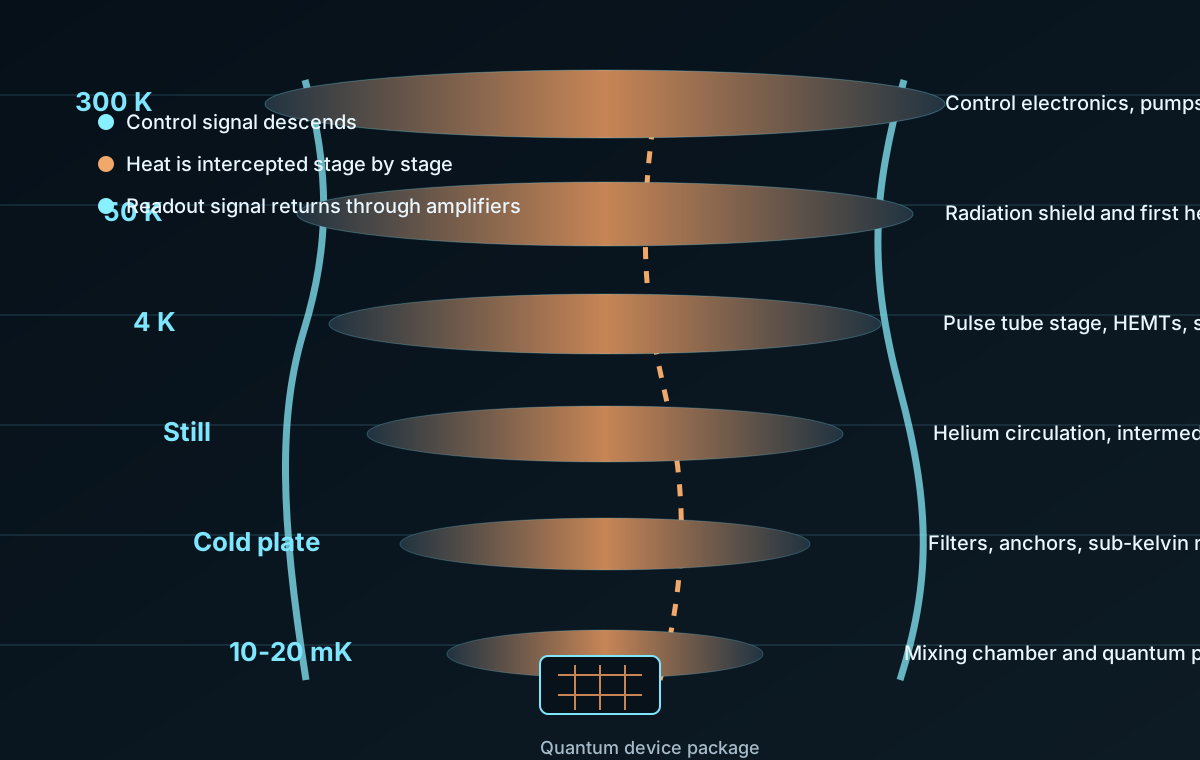
The short version
A typical superconducting quantum-computing stack descends through these layers:
| Stage | Approximate role | What usually happens there |
|---|---|---|
| Room temperature, about 300 K | Classical control and operations | Microwave sources, arbitrary waveform generators, digitizers, clocks, software, compressors, gas handling, vacuum equipment, and operators. |
| 50 K flange | First thermal intercept | Radiation shielding, first cable heat interception, pulse-tube first-stage cooling, and mechanical support. |
| 4 K flange | Main cryogenic platform | Pulse-tube second-stage cooling, shields, many low-noise amplifiers, switches, magnet options, and serviceable cold hardware. |
| Still | Intermediate dilution stage | Helium circulation, pumping-related cooling, and thermalization between 4 K and sub-kelvin regions. |
| Cold plate | Sub-kelvin integration layer | Filters, attenuators, isolators, thermal anchors, microwave packaging, and dense line routing. |
| Mixing chamber, often 10-20 mK in operation | Quantum device environment | Qubit package, final filters and isolators, parametric amplifiers, lowest-noise wiring, and the most constrained thermal budget. |
The names are conventions. For example, Bluefors notes that a system may have stages that remain around 40 K and 3 K even though the corresponding hardware plates are commonly called the 50 K flange and 4 K flange. Treat the stage labels as engineering vocabulary, not promises that every point on a plate is exactly that temperature.
Why superconducting qubits need millikelvin temperatures
The simplest explanation is that thermal energy can randomly excite microwave-frequency quantum circuits. Superconducting qubits are designed so that a controllable quantum state can be prepared, manipulated, and read out. If the environment is warm enough to populate those modes thermally, the circuit becomes harder to initialize and measure.
NIST’s 2025 technical note on cryogenic RF switch control gives a useful rule for microwave quantum experiments: for 4-8 GHz signals, keeping the quantum energy well above thermal energy can require temperatures below about 0.05 K. In practical superconducting systems, that means the chip package is commonly mounted at or near the mixing chamber of a dilution refrigerator.
This does not mean that every quantum computer uses a dilution refrigerator. Neutral atoms, trapped ions, photonic systems, and other modalities have different infrastructure. But for superconducting quantum processors, the cooling stack is inseparable from the computer.
How a dry dilution refrigerator gets cold
Modern quantum labs often use cryogen-free, or “dry,” dilution refrigerators. The phrase can be confusing. It usually means the user does not pour liquid helium into a bath during normal operation. It does not mean the system contains no helium. The dilution unit still depends on helium-3 and helium-4 circulation.
The cooldown usually proceeds in broad phases:
- The vacuum can and radiation shields isolate the cold hardware from room-temperature air and radiative heat.
- A pulse-tube cryocooler precools higher stages, commonly associated with the 50 K and 4 K flanges.
- Heat switches and heat exchangers help bring the dilution-unit stages cold enough for the helium mixture to enter the right regime.
- Helium-3 and helium-4 circulation produces continuous cooling below 1 K and ultimately at the mixing chamber.
- Once the system is cold, the real operating temperature depends on installed wiring, components, RF power, sample package heat, vibration, and measurement activity.
IBM’s Goldeneye cryogenic concept system is a useful scaling example because it frames cryogenics as part of the future data-center problem. IBM describes dry systems as using a cryocooler to provide initial 50 K and 4 K precooling for the helium mixture, then helium isotope dilution to reach millikelvin operation.
Heat flow: every connection is a thermal decision
A quantum chip cannot be isolated completely. It needs control pulses, bias lines, readout channels, clocks, triggers, sensors, and mechanical support. Every one of those connections is also a heat path. A cable that is excellent at carrying a clean microwave signal may also conduct too much heat. A component that solves an RF problem may dissipate power at a stage that has little cooling margin.
This is why cryogenic systems use thermal anchors. A cable is not cold merely because it passes through a cold stage. It has to be clamped, wrapped, soldered, or otherwise thermally connected to a stage so heat can leave the cable before it continues downward.
Good cooling-stack design asks three questions at every stage:
- What heat arrives here from warmer stages?
- What heat is generated here by attenuators, filters, amplifiers, switches, or electronics?
- How much cooling power remains for the next-colder stages and the quantum device?
The answer changes as the system gets colder. A watt-scale load may be manageable near 4 K but impossible at the mixing chamber, where cooling power is often discussed in microwatts rather than watts.
Control lines: attenuation, filtering, and thermalization
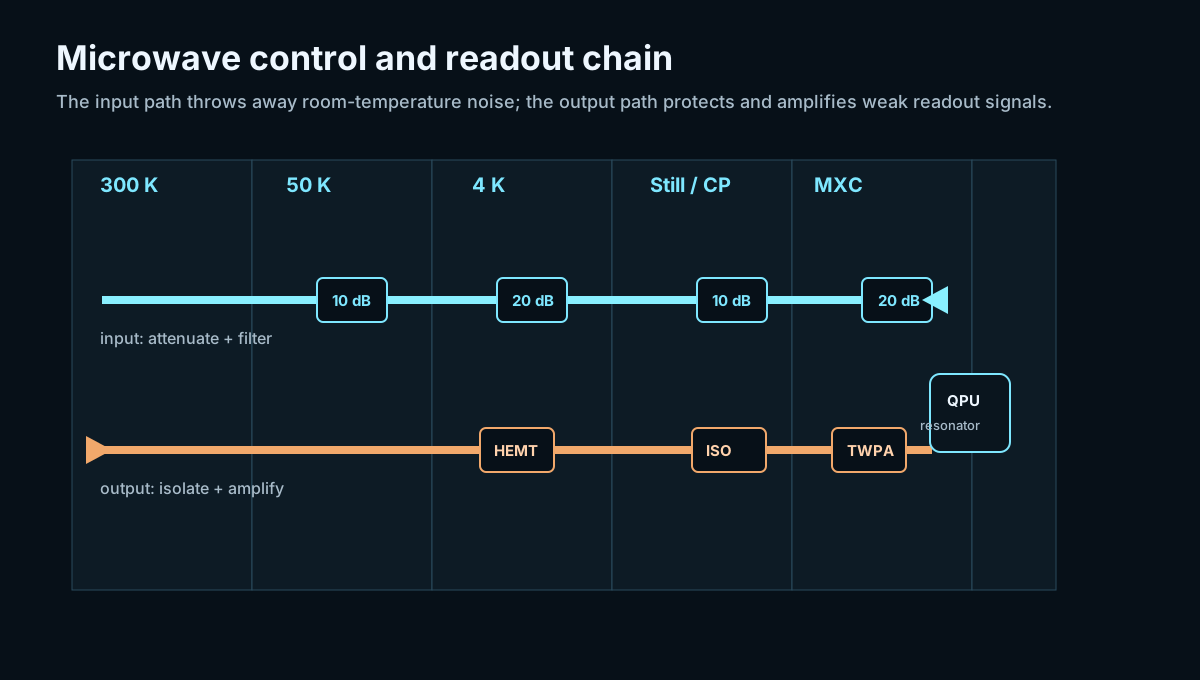
Input control lines bring microwave pulses from room-temperature electronics toward the quantum processor. Their job is not just to deliver a pulse. They also have to prevent room-temperature noise from reaching the qubit.
Distributed attenuation is the standard pattern. Attenuators are placed at multiple stages so that thermal noise is reduced as the line gets colder and so that power dissipation is spread across stages with enough cooling capacity. A 100-qubit-scale cryogenic setup paper discusses total drive-line attenuation around 60 dB and analyzes how attenuation placement affects both thermal noise photons and stage heat loads.
Filters add another layer of protection. Low-pass, band-pass, infrared, absorptive, powder, and custom filters can suppress unwanted frequency content. But filters are not free: they add insertion loss, occupy space, need thermalization, and can affect impedance matching.
The practical takeaway is simple: a control line is a negotiated path. It must carry the desired quantum-control signal while rejecting noise and shedding heat.
Readout lines: protect first, amplify early
Readout signals are tiny. If they travel all the way to room temperature before meaningful amplification, the useful information can be buried under noise. That is why readout chains often include cryogenic isolators, circulators, parametric amplifiers, and HEMT amplifiers.
The readout path usually has two jobs:
- Protect the quantum device from amplifier back-action and reflected noise.
- Amplify the signal early enough that downstream noise matters less.
In many superconducting systems, isolators and circulators sit near the coldest stages, while a HEMT amplifier is commonly mounted around the 4 K stage. Some chains use a traveling-wave parametric amplifier, or TWPA, closer to the device before the 4 K amplification stage. These components improve measurement fidelity, but they also consume space and cooling margin.
Thermal budget: the hidden scaling limit
Cooling capacity decreases dramatically as the stack descends. That makes the thermal budget one of the first places where scale-up pressure appears. A larger processor may need more control lines, more readout lines, larger packaging, more filtering, more amplification, stronger shielding, and more calibration infrastructure.
The bottleneck is rarely a single number. A design may have generous 4 K capacity but limited mixing-chamber margin. Another design may have enough cooling power but not enough physical line density, connector access, or package routing.
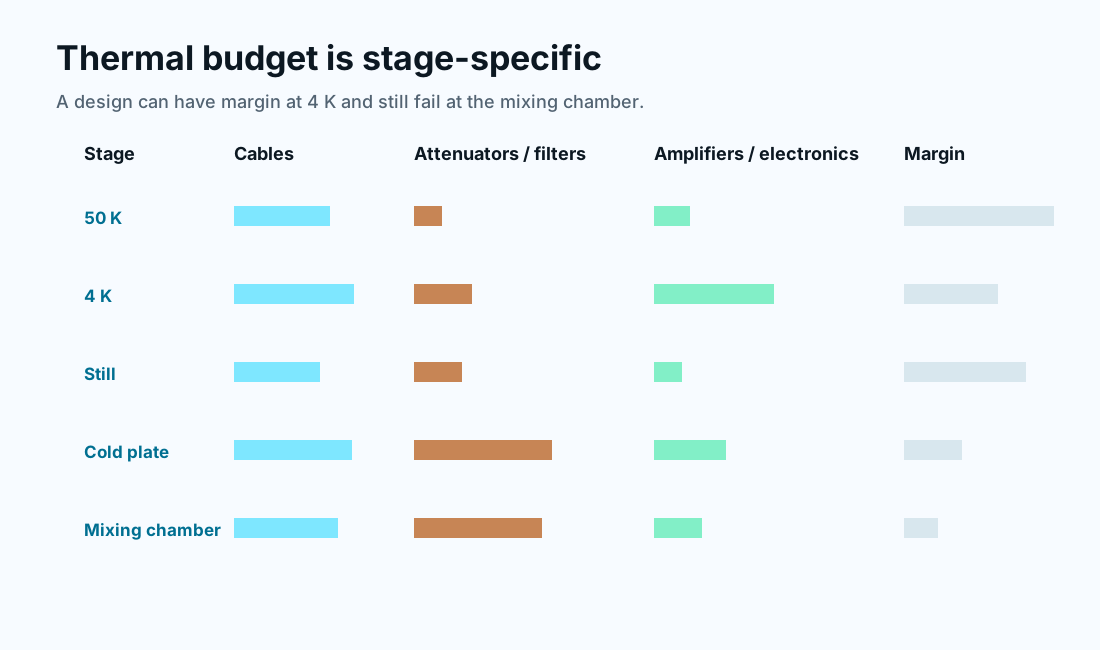
For early intuition, track these contributors:
- Passive heat conducted by coaxial cables, DC wiring, supports, and optical fibers.
- Active heat dissipated by attenuators, switches, heaters, amplifiers, and cryogenic electronics.
- Radiative heat that remains after shielding.
- Heat from imperfect thermal anchoring and poor mechanical contact.
- RF power delivered during control and readout.
- Cooldown time and operational turnaround after hardware changes.
Wiring density and packaging
The most recognizable quantum-computer image is a chandelier-like assembly of plates and cables. That image is not decorative. It reveals a scaling constraint. Each additional signal path needs physical routing, thermalization, filtering, shielding, and documentation.
High-density wiring aims to increase the number of usable lines without overwhelming the cryostat. Flexible cryogenic interconnects, multiplexing, cryogenic switches, and cryo-CMOS can all help, but each approach creates new tradeoffs in heat, noise, reliability, repairability, and manufacturability.
For a buyer, investor, or technical reader, the important lesson is that qubit count alone does not describe a system. A serious system description should also mention line count, thermal budget, package design, amplifier architecture, cooldown time, and measurement infrastructure.
Common misconceptions
Misconception: The gold chandelier is the quantum computer.
The visible structure is the staged refrigerator and wiring environment. The quantum processor package is usually much smaller and mounted near the coldest stage.
Misconception: 4 K is cold enough for superconducting quantum processors.
The 4 K stage is important, especially for amplifiers and shielding, but many superconducting qubits operate near the mixing chamber in the tens-of-millikelvin range.
Misconception: Base temperature tells the whole story.
Base temperature is often measured under limited load. Installed wiring, filters, amplifiers, packages, and measurement power determine the real operating environment.
Misconception: More attenuation is always better.
Attenuation reduces noise, but it dissipates power. Placement matters because the same attenuation can create very different heat loads depending on stage.
Misconception: Cryogen-free means helium-free.
Dry dilution refrigerators reduce routine liquid-helium handling, but they still rely on helium gas and helium isotope circulation.
How to read a supplier cooling-stack claim
When a vendor describes a cryogenic platform for quantum computing, read the specification in layers:
- What base temperature and loaded temperature are claimed?
- What cooling power is available at the mixing chamber and at 4 K?
- How many coaxial, DC, optical, and pump lines are installed or supported?
- Are the wiring and filters included, or only the refrigerator platform?
- What is the cooldown and warm-up time for realistic service work?
- How are pulse-tube vibration, acoustic noise, grounding, and shielding handled?
- How much experimental space is available after wiring and shields are installed?
- What software, gas handling, diagnostics, and service model are included?
The strongest claims explain conditions. The weakest claims show a cold number with little information about load, wiring, or measurement context.
Related QCRY pages
- What Is Quantum Cryogenics?
- Dilution Refrigerators
- Cryogenic Wiring for Quantum Computers
- Cryogenic Attenuators, Filters, and Isolators
- Cryogenic Thermal Budget Calculator
- Cooling-Stage Visualizer
FAQ
What temperature does a quantum computer need?
For superconducting quantum computers, the processor is commonly operated in the millikelvin range, often near 10-20 mK at the mixing chamber. Other quantum-computing modalities may use very different temperature requirements.
Why does the cooling stack have so many stages?
The stages progressively remove heat and noise. It is easier to intercept heat at warmer stages than to let it reach the mixing chamber, where cooling power is extremely limited.
What is the difference between a cryostat and a dilution refrigerator?
A cryostat is the low-temperature environment, including vacuum space, shields, plates, feedthroughs, and sample access. A dilution refrigerator is a specific cooling system that uses helium-3 and helium-4 dilution to reach millikelvin temperatures.
Why are attenuators cold?
Attenuators reduce thermal noise and signal power. Placing them at cold stages helps thermalize the microwave environment seen by the qubit, but their dissipated power must fit the thermal budget.
Where is the quantum chip?
In many superconducting systems, the chip package is mounted at or near the mixing chamber, the coldest stage of the dilution refrigerator.
Research sources and further reading
- Bluefors, “Components of the Dilution Refrigerator Measurement System”: https://bluefors.com/stories/components-of-the-dilution-refrigerator-measurement-system/
- Bluefors, “Cryogenic Measurement Infrastructure for Quantum Computing”: https://bluefors.com/stories/cryogenic-measurement-infrastructure-for-quantum-computing/
- NIST, “The Big Quantum Chill”: https://www.nist.gov/news-events/news/2024/04/big-quantum-chill-nist-scientists-modify-common-lab-refrigerator-cool
- NIST, “Quantum Characterization”: https://www.nist.gov/programs-projects/quantum-characterization
- NIST Technical Note 2335, “MEMSDuino: An Arduino-Based MEMS Switch Controller”: https://nvlpubs.nist.gov/nistpubs/TechnicalNotes/NIST.TN.2335.pdf
- IBM Quantum, “Goldeneye cryogenic concept system”: https://www.ibm.com/quantum/blog/goldeneye-cryogenic-concept-system
- EPJ Quantum Technology, “Engineering cryogenic setups for 100-qubit scale superconducting circuit systems”: https://link.springer.com/article/10.1140/epjqt/s40507-019-0072-0