Cryogenic Attenuators, Filters, and Isolators
Attenuators, filters, and isolators are the parts that keep a quantum system from hearing too much of the warm, noisy outside world. They shape what signals can enter the device and what fragile readout signals can escape.
At a deeper level, their placement is the design problem. The same component can be useful or harmful depending on its stage, thermal contact, frequency band, insertion loss, isolation, dissipation, and effect on the readout chain.
Attenuators, filters, and isolators are the microwave hygiene components of a quantum cryogenic system. They do not cool the refrigerator by themselves, but they help make the cold environment electrically usable for superconducting qubits, resonators, detectors, and other sensitive devices.
The easiest way to understand these parts is to follow a signal line. On the way down, the system tries to deliver a clean control pulse while stripping away room-temperature noise. On the way back up, the system tries to protect a tiny readout signal, prevent amplifier noise from traveling backward, and amplify early enough that the information is not lost.
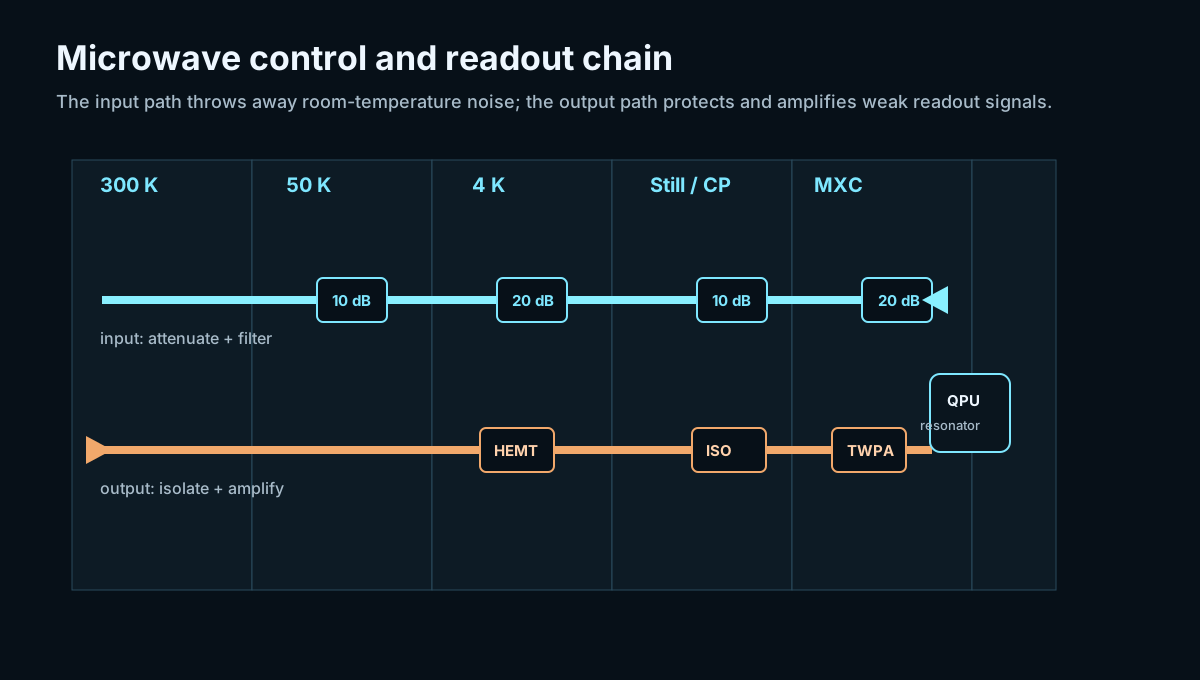
What each component does
| Component | Primary job | Main tradeoff |
|---|---|---|
| Attenuator | Reduces signal power and thermal noise on input/control lines | Dissipates heat at the stage where it is mounted. |
| RF filter | Suppresses unwanted frequency content | Adds insertion loss and may absorb power as heat. |
| Infrared or absorptive filter | Blocks high-frequency radiation and broadband noise | Needs good thermalization; can be bulky or lossy. |
| Isolator | Allows signal flow in one direction and suppresses reverse noise | Adds insertion loss, requires magnetic shielding, and occupies cold-stage space. |
| Circulator | Routes signals between ports in a direction-dependent way | Similar constraints to isolators; often used in readout chains. |
Why attenuation is distributed
If all attenuation were placed at room temperature, the line could still carry thermal noise from warmer stages. If all attenuation were placed at the mixing chamber, the coldest stage would have to absorb too much dissipated power. Distributed attenuation spreads the thermal work across stages.
Research on 100-qubit-scale superconducting setups discusses drive-line attenuation around 60 dB and compares how attenuator placement affects both thermal noise photons and stage heat loads. This is the core design tension: reduce noise enough without spending the entire thermal budget.
Where filters fit
Filters target specific spectral problems. Low-pass filters suppress high-frequency content. Band-pass filters preserve a measurement band. Infrared and absorptive filters reduce unwanted radiation or broadband energy. Filters are often mounted where they can be thermalized and where their insertion loss is acceptable.
For input lines, filters protect the device from noise and spurs. For readout lines, filters must be chosen carefully because any loss before amplification can degrade measurement quality.
Isolators and readout protection
The readout chain is vulnerable because the measured signal is weak. Isolators and circulators help prevent amplifier back-action and reflected noise from reaching the qubit or resonator. They are commonly used near the coldest stages, followed by parametric amplification and then HEMT amplification near 4 K.
Practical checklist
- Define whether the line is input, output, pump, flux, or calibration.
- Place attenuation by noise requirement and stage cooling capacity.
- Treat filter power absorption as a heat load.
- Avoid unnecessary loss before the first readout amplifier.
- Check magnetic shielding and field compatibility for isolators and circulators.
- Confirm cryogenic measurements, not only room-temperature specifications.
- Document the chain as installed, including cable loss.
Related pages
Research sources
- EPJ Quantum Technology, 100-qubit-scale cryogenic setup: https://link.springer.com/article/10.1140/epjqt/s40507-019-0072-0
- NIST Technical Note 2335: https://nvlpubs.nist.gov/nistpubs/TechnicalNotes/NIST.TN.2335.pdf
- Bluefors measurement infrastructure: https://bluefors.com/stories/cryogenic-measurement-infrastructure-for-quantum-computing/