Cryogenic Wiring for Quantum Computers
Wiring is how the outside world talks to the cold device. Every line that carries a signal down also tries to carry heat down, which is why cryogenic wiring is never just an installation detail.
The expert layer is a set of tradeoffs: thermal conductivity against microwave loss, attenuation against heat dissipation, connector density against reliability, and stage-by-stage anchoring against serviceability.
Cryogenic wiring is the nervous system of a superconducting quantum computer. It carries microwave pulses, DC bias, flux control, readout signals, pump tones, sensor signals, triggers, and sometimes optical connections between room-temperature electronics and devices mounted near the millikelvin mixing chamber.
Every wire is also a thermal problem. A perfect signal path that overloads the mixing chamber is not a usable signal path. Cryogenic wiring design therefore balances microwave loss, thermal conduction, line density, connector reliability, filtering, grounding, shielding, and serviceability.
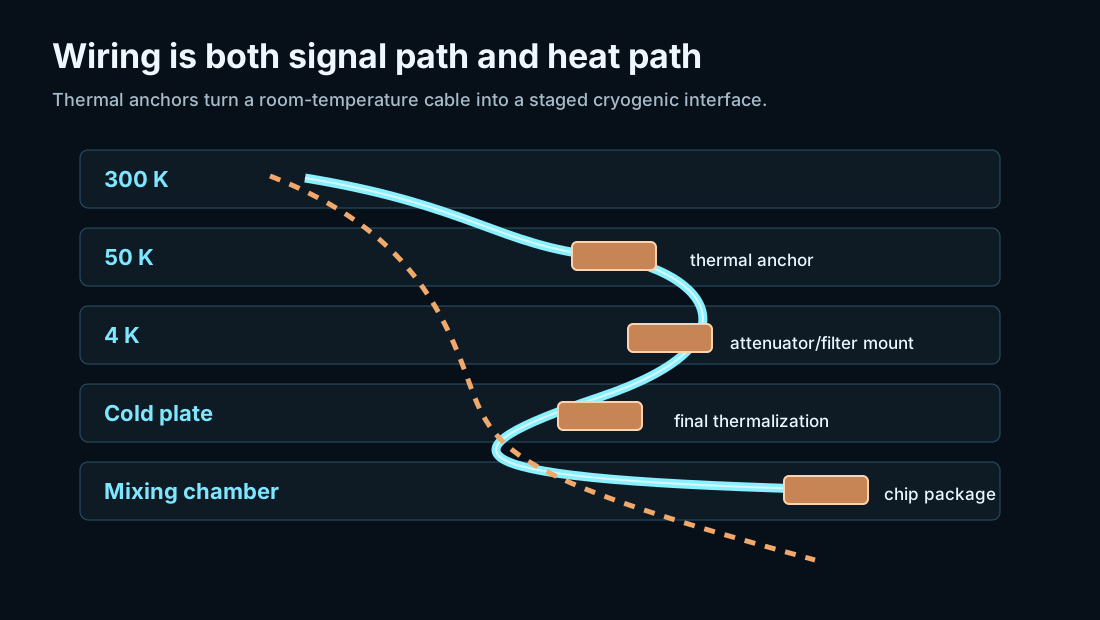
The two budgets
Cryogenic wiring has two simultaneous budgets:
- Signal budget: insertion loss, impedance match, bandwidth, attenuation, crosstalk, phase stability, and readout signal-to-noise ratio.
- Thermal budget: passive heat conduction, active dissipation in attenuators and filters, stage cooling power, and remaining margin for the quantum package.
Those budgets compete. Copper improves conductivity and can reduce microwave loss, but it conducts heat. Stainless steel and cupronickel reduce heat leak, but increase loss. Superconducting materials can reduce loss in cold sections, but add cost, material constraints, and integration details.
Common line families
| Line family | Common use | Design issue |
|---|---|---|
| Drive coax | Microwave qubit-control pulses | Distributed attenuation, filtering, thermalization, crosstalk. |
| Readout coax | Resonator output and measurement | Low loss before amplification, isolators, parametric amplifiers, HEMTs. |
| Flux/DC lines | Bias and tuning | Filtering, thermal conduction, noise pickup, current capacity. |
| Pump lines | Parametric-amplifier pump tones | Power level, attenuation, heat load, isolation. |
| Sensor/heater wiring | Temperature measurement and stage control | Accuracy, grounding, low thermal load, service reliability. |
| Optical fiber | Detector and photonic systems | Feedthroughs, anchoring, bend radius, blackbody filtering. |
Thermalization practice
Thermalization is the process of making a line reach the temperature of the stage it passes through. Practical approaches include clamps, bobbins, soldered thermalization points, copper blocks, attenuator bodies mounted to plates, filter housings, and strain-relief brackets.
Good thermalization is not just about touching metal. Surface finish, contact area, torque, plating, oxide layers, cable stiffness, and thermal cycling all matter. A line that is not well thermalized can deliver unwanted heat and noise even if the refrigerator base temperature looks acceptable.
Attenuation and filtering
Input microwave lines often use attenuation distributed across stages. This reduces thermal noise seen by the qubit and prevents too much power from being dissipated at any single stage. Filters add spectral control, suppressing unwanted bands, infrared radiation, or broadband noise.
A useful mental model is this: attenuation lowers the temperature of the microwave environment, while filters choose which parts of the spectrum are allowed to pass. Both must be mounted where their heat and loss can be managed.
Readout wiring
Readout wiring is more fragile than input wiring because the signal leaving the device is weak. The chain commonly uses isolators or circulators near cold stages to protect the device, a parametric amplifier near the mixing chamber or cold plate when needed, and a HEMT amplifier near 4 K.
The cable between the first cold amplification stage and the device is especially important. Loss there can degrade signal-to-noise before the signal has been boosted.
Scaling issues
As systems scale, wiring becomes a density problem. More lines create more heat, more connector count, more assembly labor, more failure points, and more calibration complexity. High-density wiring, multiplexing, cryogenic switches, and cryo-CMOS are all attempts to reduce or reorganize this burden.
Checklist
- Define line purpose before choosing cable material.
- Model passive heat leak by stage.
- Place attenuation where both noise and thermal load are acceptable.
- Avoid unnecessary loss before the first readout amplifier.
- Use repeatable thermal anchoring and strain relief.
- Keep routing readable for service and debugging.
- Record installed line maps, not just bill-of-materials entries.
Related pages
Research sources
- Bluefors measurement infrastructure: https://bluefors.com/stories/cryogenic-measurement-infrastructure-for-quantum-computing/
- EPJ Quantum Technology, 100-qubit-scale cryogenic setup: https://link.springer.com/article/10.1140/epjqt/s40507-019-0072-0
- NIST Technical Note 2335: https://nvlpubs.nist.gov/nistpubs/TechnicalNotes/NIST.TN.2335.pdf