Quantum Cryogenics Benchmarks
A benchmark is only useful if you know what was being measured. In cryogenics, an empty base-temperature number can look impressive while telling you little about a loaded system full of cables, filters, amplifiers, and a real package.
The advanced task is comparing conditions: cooling power at a stated temperature, installed wiring, sample volume, vibration, noise, cooldown time, measurement method, and service assumptions.
Benchmarks are useful only when they help real comparisons. QCRY does not certify equipment, but it can organize public specifications, explain what metrics mean, and identify what is missing from public datasheets.
In cryogenics, a benchmark is only useful when the conditions are clear. A base temperature measured without wiring is different from a loaded operating temperature. A cooling-power number at 100 mK is different from one at 20 mK. A cable-loss number at room temperature may not describe the installed cold assembly.
Benchmark categories
| Benchmark | What to capture |
|---|---|
| Base temperature | Empty or loaded, measurement location, cooldown state. |
| Mixing-chamber cooling power | Temperature point, load conditions, margin. |
| 4 K cooling power | Available power for shields, HEMTs, switches, wiring, and options. |
| Cooldown time | From room temperature to operating point, including realistic system configuration. |
| Wiring capacity | Coax, DC, optical, pump, and sensor lines; installed vs available. |
| Sample space | Usable volume after shields, wiring, filters, and packages. |
| Vibration and acoustic noise | Measurement method, pulse-tube isolation, compressor location. |
| RF chain performance | Loss, gain, noise temperature, isolation, filtering, and stage placement. |
| Serviceability | Time to access sample, replace components, warm up, and recover. |
Why simple rankings fail
Quantum cryogenic systems are application-dependent. A detector lab may prioritize compact uptime. A superconducting qubit team may prioritize line density, microwave chain quality, and mixing-chamber margin. A materials lab may prioritize magnets, sample exchange, and measurement flexibility.
That is why benchmark pages work best as families of comparisons, not a single score.
Data quality labels
- Public vendor specification: useful when the measurement conditions are visible.
- Application note or white paper: often richer than a datasheet, but still vendor-framed.
- Peer-reviewed measurement: stronger evidence when conditions are close to the target use case.
- Independent lab measurement: useful when methods are transparent.
- QCRY estimate: labeled as an estimate, not certification.
Related pages
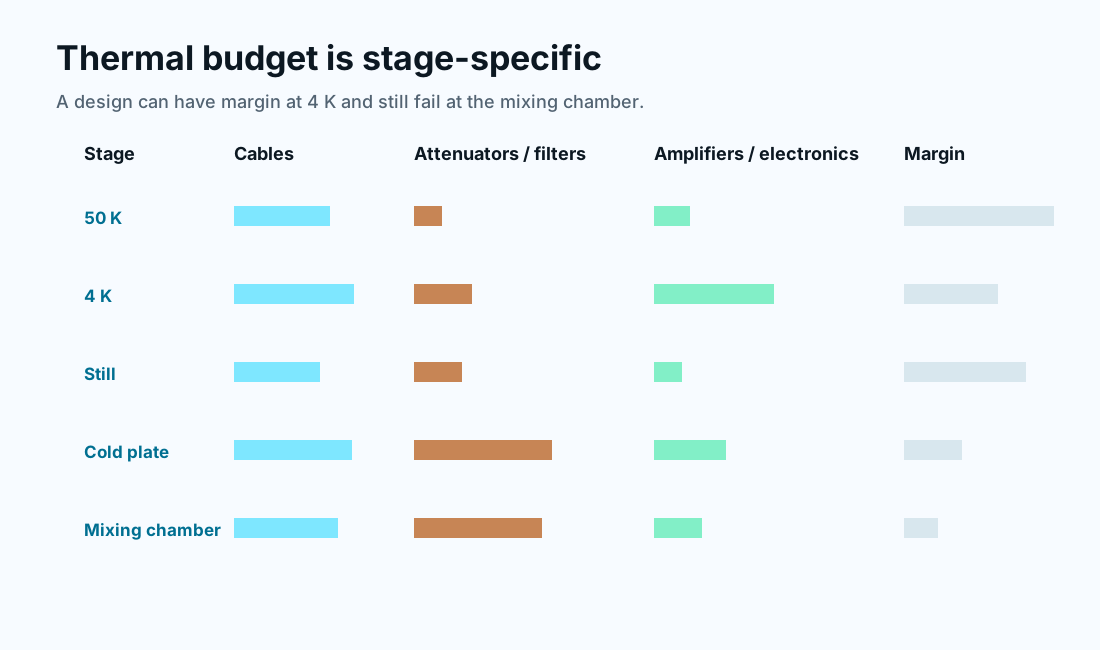
What the diagram shows
Research sources
- IBM Goldeneye: https://www.ibm.com/quantum/blog/goldeneye-cryogenic-concept-system
- Bluefors dilution refrigerator components: https://bluefors.com/stories/components-of-the-dilution-refrigerator-measurement-system/
- EPJ Quantum Technology, 100-qubit-scale setup: https://link.springer.com/article/10.1140/epjqt/s40507-019-0072-0