Cryogenic Cable
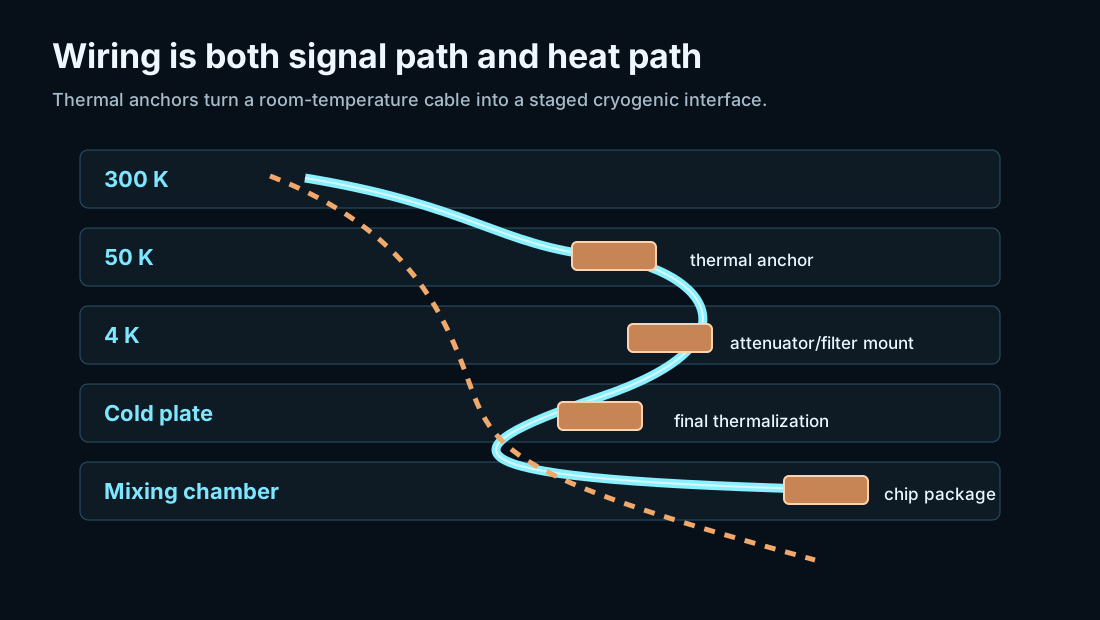
A cryogenic cable has two jobs that fight each other. It must carry a useful signal, and it must avoid carrying too much heat toward the coldest part of the refrigerator.
The advanced tradeoff depends on material, frequency, attenuation, connector repeatability, shielding, superconducting sections, thermal anchors, and the stage where the cable is used.
Cryogenic cable connects room-temperature instrumentation to devices operating inside a cryostat or dilution refrigerator. In quantum computing, a cable is never just a cable. It is a microwave path, a DC path, a mechanical object, a source of insertion loss, a possible noise path, and a thermal conductor from warm hardware toward the coldest stages.
The cable problem is central to scale-up. More qubits usually means more control, bias, readout, pump, sensor, and calibration lines. Every additional line needs routing, connectors, thermal anchoring, documentation, service access, and stage-by-stage heat interception.
What cryogenic cables do
Different lines serve different jobs:
| Line type | Typical use | Key design pressure |
|---|---|---|
| Microwave coax | Qubit drive, readout, resonator measurement, pump tones | Low loss, stable impedance, shielding, connector quality, thermal load. |
| DC wiring | Bias, flux control, sensors, heaters, switches | Low thermal conduction, filtering, current capacity, noise pickup. |
| Twisted pair | Low-frequency measurement and control | Heat leak, crosstalk, filtering, connector density. |
| Superconducting coax | Low-loss cold-stage microwave routing | Reduced loss at low temperature, material transitions, magnetic compatibility. |
| Optical fiber | Photonic systems, detector modules, timing, transduction | Fiber feedthroughs, thermal anchoring, bend radius, blackbody radiation control. |
Cable material tradeoffs
Copper is an excellent electrical conductor, but it also conducts heat well. Stainless steel, cupronickel, phosphor bronze, and other lower-thermal-conductivity materials can reduce heat leak but may increase microwave loss. Superconducting materials such as NbTi can reduce loss in cold sections, but they introduce their own handling, connector, shielding, and magnetic-environment considerations.
This is why cable choice often changes by stage. A room-temperature-to-4 K segment may use a material that limits heat conduction. A mixing-chamber-to-amplifier segment may use a low-loss superconducting cable because readout signal quality is precious after the quantum device.
What specifications matter
For quantum cryogenics, useful cable specifications include:
- Frequency range and characteristic impedance.
- Insertion loss at room temperature and at cryogenic temperature.
- Thermal conductivity or heat leak between stages.
- Connector type and repeatability after thermal cycling.
- Shielding effectiveness and grounding strategy.
- Bend radius, stiffness, routing density, and strain relief.
- Magnetic behavior.
- Compatibility with thermal anchors and filters.
- Cleanliness, vacuum compatibility, and installation constraints.
Failure modes
Cables can quietly degrade a quantum experiment. Common failure modes include connector loosening after thermal cycling, insufficient thermal anchoring, poor strain relief, impedance mismatch, unexpected loss, ground loops, crosstalk, damaged dielectric, connector contamination, and routing that blocks service access.
Buyer questions
- Is the cable specified at cryogenic temperature, or only at room temperature?
- What heat load does it introduce between each stage?
- Which connectors are qualified for repeated cooldowns?
- Is the cable intended for the input/control path or output/readout path?
- How should it be clamped or thermalized at 50 K, 4 K, cold plate, and mixing chamber?
- Does the supplier provide measured S-parameters for the installed assembly?
Related pages
- The Quantum Computing Cooling Stack
- Cryogenic Wiring for Quantum Computers
- Thermal Anchor
- Cryogenic Thermal Budgeting
Research sources
- Bluefors high-density and coaxial wiring categories: https://bluefors.com/stories/cryogenic-measurement-infrastructure-for-quantum-computing/
- EPJ Quantum Technology, “Engineering cryogenic setups for 100-qubit scale superconducting circuit systems”: https://link.springer.com/article/10.1140/epjqt/s40507-019-0072-0
- NIST Technical Note 2335: https://nvlpubs.nist.gov/nistpubs/TechnicalNotes/NIST.TN.2335.pdf