Cryogenic Thermal Budget Calculator
This calculator is a teaching tool for the heat budget problem. Add lines and active loads, and you can see how quickly a cold stage starts spending its available cooling power.
For advanced work, replace the defaults with measured or supplier-provided values. The important lesson is stage-by-stage accounting, not a universal answer.
The QCRY thermal budget calculator helps readers understand how heat loads accumulate inside a cryogenic system. It is educational first: a planning and intuition tool, not a replacement for vendor engineering or detailed finite-element modeling.
What the calculator estimates
Inputs:
- Number of coaxial lines.
- Cable type or assumed thermal behavior.
- Number and value of attenuators by stage.
- Filters and terminations by stage.
- Cryogenic amplifiers and their power dissipation.
- Cryo-CMOS or active electronics power.
- Optical fibers or DC wiring where relevant.
- Cooling power assumptions for each stage.
Outputs:
- Estimated load by temperature stage.
- Remaining stage margin.
- Which stage is the bottleneck.
- Warnings when the mixing chamber budget is exceeded.
- Suggestions for related guide pages.
What it teaches
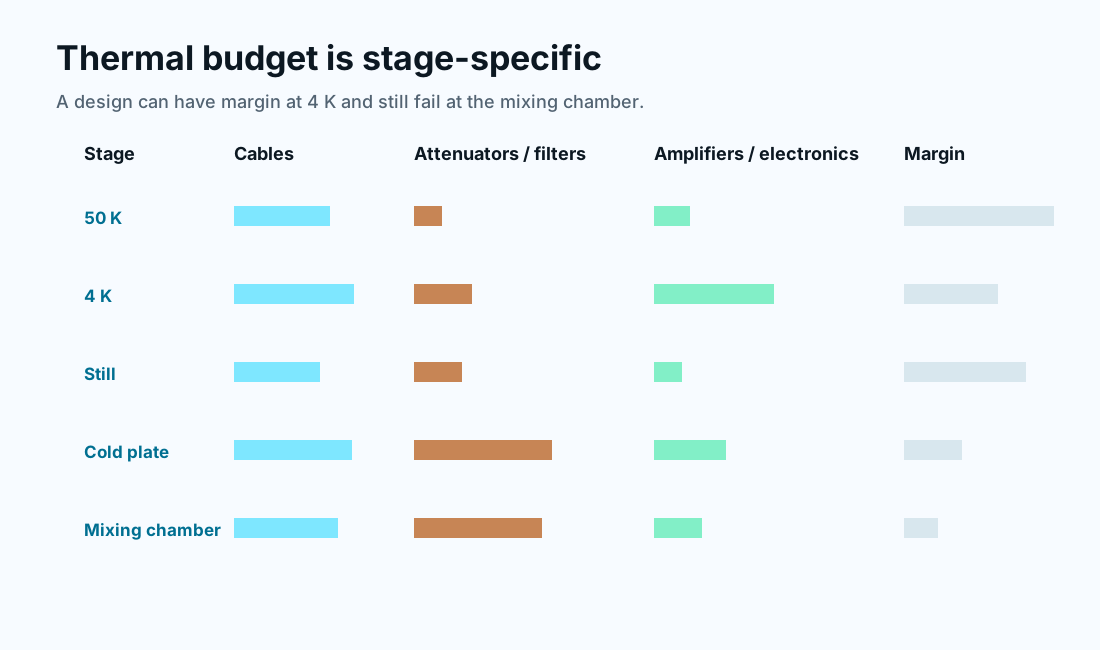
Thermal budgeting is not a single number. A system can be safe at 4 K and overloaded at the mixing chamber. A component can be electrically useful but thermally expensive. A high line count can fail for reasons that have nothing to do with qubit design.
What the diagram shows
Interactive behavior
The calculator shows estimated loads by stage. As line count and active load change, the stage values update immediately so readers can see how cable count and component dissipation affect the 50 K, 4 K, still, cold plate, and mixing chamber regions.
Internal links
Research sources
- Bluefors dilution refrigerator systems: https://bluefors.com/products/dilution-refrigerator-measurement-systems/
- EPJ Quantum Technology cryogenic engineering paper: https://link.springer.com/article/10.1140/epjqt/s40507-019-0072-0
- RF Essentials thermal budget explainer: https://rfessentials.com/rf-knowledge-base/how-do-i-calculate-the-thermal-budget-for-microwave-components-at-the-mixing-cha/