Cryogenic Thermal Budgeting
A thermal budget is an accounting sheet for heat. It asks how much heat each refrigerator stage can remove and how much heat cables, components, radiation, and active electronics are adding.
The hard part is that every design choice spends some of that budget. More lines, better readout, denser packaging, and cryogenic electronics can all be valuable, but each has to fit inside the cooling power available at the relevant stage.
Cryogenic thermal budgeting is the practice of accounting for heat loads at each temperature stage of a cryostat or dilution refrigerator. It is one of the most important engineering disciplines in quantum hardware because every useful connection into the cryostat also creates a heat path.
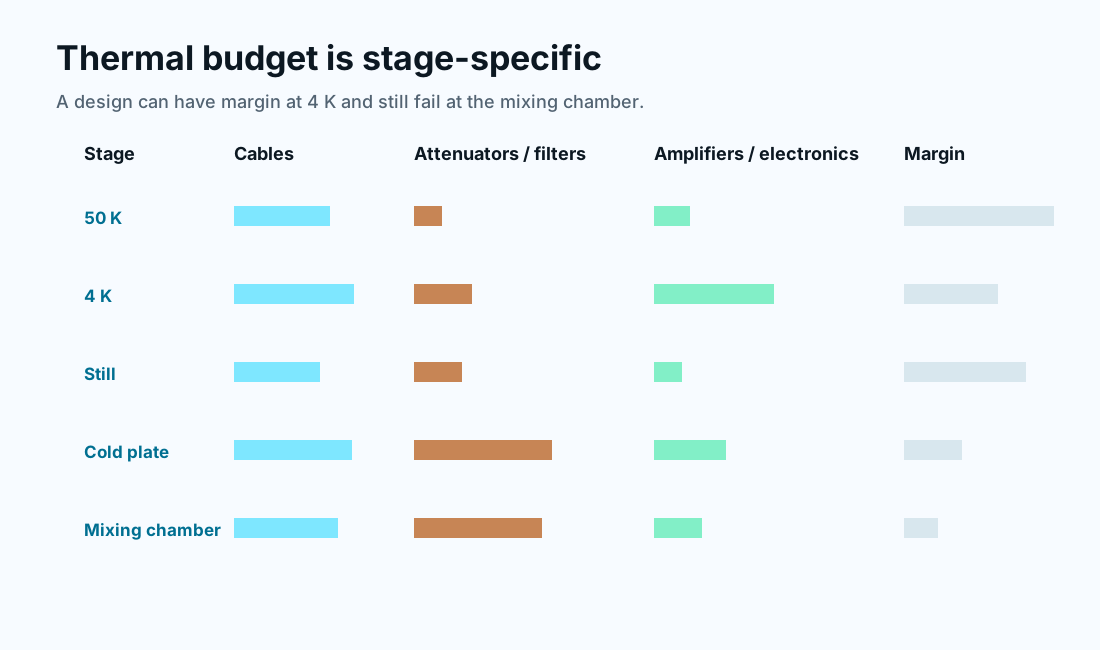
A thermal budget is not a single number. A system can have plenty of capacity at 4 K and still be overloaded at the mixing chamber. It can reach an impressive base temperature when empty and fail to operate at that temperature after wiring, filters, amplifiers, and a sample package are installed.
What creates heat load
| Heat source | Example | Why it matters |
|---|---|---|
| Conducted heat | Coaxial cables, DC wires, supports, optical fibers | Heat travels from warmer stages toward colder stages unless intercepted. |
| Dissipated RF power | Attenuators, filters, terminations, pump lines | Useful microwave conditioning can spend cooling power. |
| Active electronics | HEMT amplifiers, switches, cryo-CMOS, heaters | Power dissipation can dominate a stage if not planned. |
| Radiation | Warm surfaces facing cold shields | Vacuum and radiation shields reduce this load. |
| Poor contact | Loose clamps, oxide layers, weak thermal anchors | Components may not reach the temperature of the stage they sit on. |
| Operations | Cooldown, warmup, sample exchange, switching events | Time and transient heating affect usable throughput. |
Stage-specific thinking
The 50 K and 4 K stages usually have far more cooling capacity than the mixing chamber. That does not make them unlimited. A system with high line count, active electronics, or poorly planned attenuation can still consume too much stage margin.
The cold plate and mixing chamber require special discipline. These stages host the components closest to the quantum device. The available cooling power is smaller, the physical routing is denser, and the cost of adding another dissipative component is higher.
Cable heat
Cables are often the first thermal-budget surprise. A cable material with low microwave loss may conduct significant heat. A material with low thermal conductivity may add signal loss. Good designs often use different materials for different temperature spans and then anchor the cable repeatedly.
Attenuator heat
Attenuators intentionally dissipate signal power. That is part of how they work. The question is where the heat should be spent. Distributed attenuation reduces thermal noise while spreading heat across stages with appropriate capacity.
Amplifier and electronics heat
Cryogenic amplifiers improve readout but dissipate power. Cryo-CMOS and cryogenic switches can reduce wiring burden, but they move active electronics into the refrigerator. The value proposition must include the heat they add and the wiring they remove.
A practical thermal-budget workflow
- List every cable, component, package, sensor, shield, and active device by stage.
- Estimate passive conduction between stages.
- Add dissipated power from attenuators, filters, amplifiers, heaters, and electronics.
- Compare loaded heat against cooling power at each stage.
- Preserve margin for measurement power, installation uncertainty, and future changes.
- Validate with stage temperature measurements after cooldown.
- Update the budget whenever wiring or components change.
Related pages
- Cryogenic Thermal Budget Calculator
- Cryogenic Cable
- Thermal Anchor
- The Quantum Computing Cooling Stack
Research sources
- EPJ Quantum Technology, 100-qubit-scale cryogenic setup: https://link.springer.com/article/10.1140/epjqt/s40507-019-0072-0
- Bluefors, “Components of the Dilution Refrigerator Measurement System”: https://bluefors.com/stories/components-of-the-dilution-refrigerator-measurement-system/
- NIST, “The Big Quantum Chill”: https://www.nist.gov/news-events/news/2024/04/big-quantum-chill-nist-scientists-modify-common-lab-refrigerator-cool