Cryogenic Temperature Converter
Temperature units become strange near absolute zero. A number like 20 mK is easy to say and hard to feel, so this page helps translate between everyday units and cryogenic units.
The deeper point is scale: a tiny difference in kelvin can matter enormously when thermal energy is comparable to microwave quantum energies or when a stage has very limited cooling power.
The QCRY temperature converter is a simple utility for quantum cryogenics. It converts Kelvin, millikelvin, Celsius, and Fahrenheit while teaching readers what each temperature means in a real quantum system.
Why this tool matters
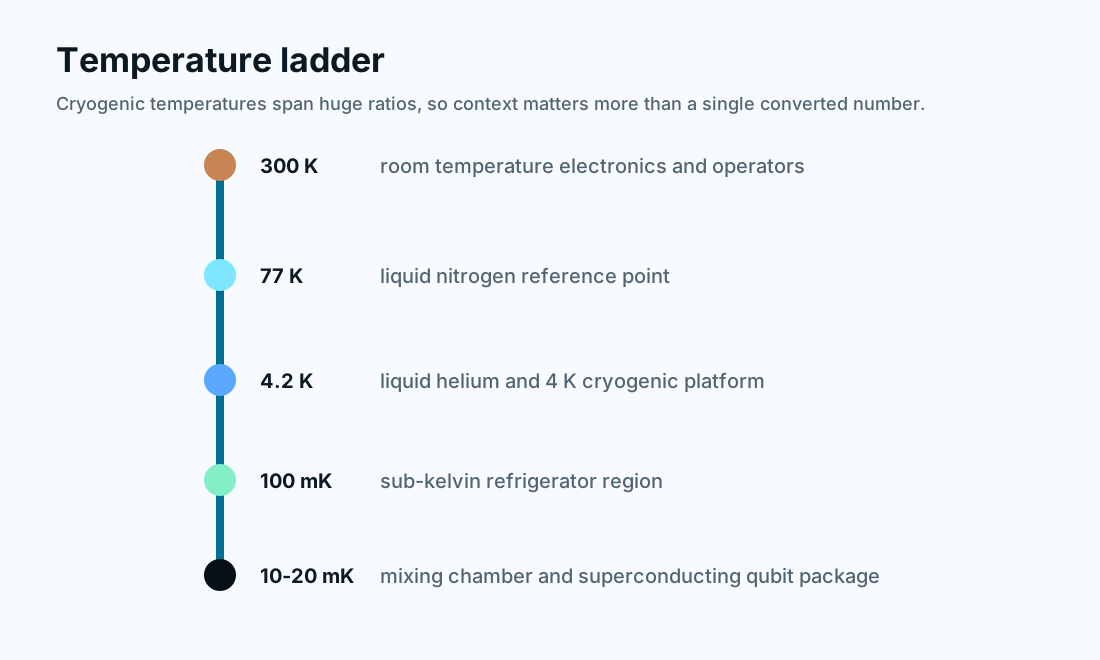
Quantum cryogenics is full of temperature references that are unintuitive to newcomers: 300 K, 77 K, 4 K, 1 K, 100 mK, 20 mK, and 10 mK. A normal unit converter gives a number. QCRY gives context.
For example:
- 300 K is near room temperature.
- 77 K is near liquid nitrogen temperature.
- 4.2 K is near liquid helium boiling temperature at atmospheric pressure.
- 10 mK is a typical order-of-magnitude target for the coldest stage of many dilution refrigerator experiments.
Exact formulas
Use standard temperature conversion formulas:
- Celsius = Kelvin - 273.15.
- Kelvin = Celsius + 273.15.
- Fahrenheit = Celsius x 9/5 + 32.
- Celsius = (Fahrenheit - 32) x 5/9.
- Millikelvin = Kelvin x 1000.
- Kelvin = millikelvin / 1000.
Negative Celsius and Fahrenheit values can look extreme in familiar scales, so Kelvin and millikelvin remain the most useful references for cryogenic work.
Common conversions
- 10 millikelvin is 0.01 K, about -273.14 C.
- 4 K is about -269.15 C.
- A superconducting quantum processor can operate in the tens-of-millikelvin range, colder than ordinary cryogenic storage and colder than the cosmic microwave background.
- Scientists use Kelvin because it is an absolute scale: 0 K corresponds to absolute zero.
What the diagram shows
Internal links
Research sources
- NIST SI temperature information: https://www.nist.gov/pml/owm/si-units-temperature
- NIST cryogenics: https://www.nist.gov/mml/acmd/cryogenic-technologies-project/about-cryogenics