RF Filter
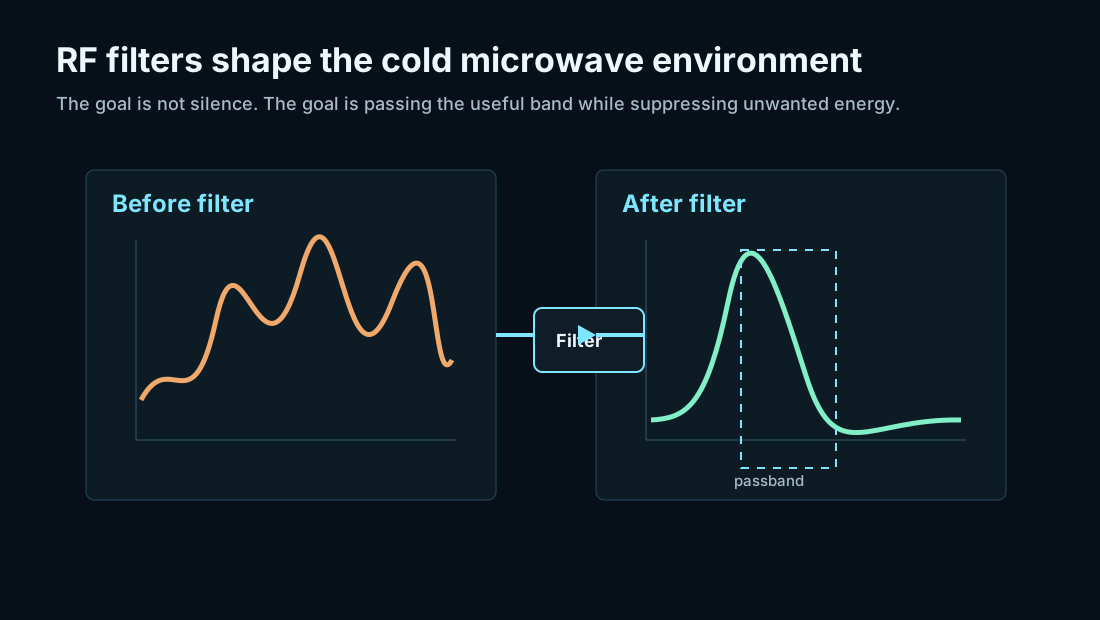
An RF filter decides which parts of a signal are allowed to pass. In a quantum cryogenic system, filtering is one way to keep unwanted noise from reaching a sensitive device.
The advanced design problem is placement: a filter has electrical behavior, thermal mass, heat sinking needs, passband limits, package effects, and sometimes magnetic or power-handling constraints.
An RF filter passes desired frequency content and suppresses unwanted frequency content. In quantum cryogenic systems, filters help create an electrically quiet environment for qubits, detectors, resonators, sensors, and low-temperature measurement devices.
Filters are part of a larger microwave hygiene strategy. Attenuators reduce thermal noise and signal power. Isolators and circulators protect readout paths. Shielding and grounding reduce environmental coupling. Filters specifically target unwanted spectral content such as harmonics, broadband noise, infrared radiation, spurs, and out-of-band microwave energy.
Types of cryogenic filters
| Filter type | Typical purpose | Tradeoffs |
|---|---|---|
| Low-pass filter | Blocks high-frequency noise above the useful band | May add insertion loss and must be placed where heat can be removed. |
| Band-pass filter | Passes a measurement band while rejecting out-of-band energy | Requires careful impedance matching and bandwidth choice. |
| Infrared filter | Reduces high-energy radiation that can disturb cold devices | Often used near cold stages; can add loss and heat load. |
| Absorptive filter | Absorbs unwanted energy rather than reflecting it | Dissipated energy becomes heat at the mounted stage. |
| Powder or custom filters | Specialized low-temperature filtering for sensitive lines | Can be bulky, lossy, or difficult to characterize across all conditions. |
Placement matters
The same filter can have different consequences depending on where it is mounted. A filter at room temperature can reduce instrument noise or harmonics before signals enter the cryostat. A filter at 4 K or the cold plate can reduce noise closer to the device, but any absorbed power must fit the cooling budget. A filter at the mixing chamber can protect the device environment, but the millikelvin heat budget is extremely constrained.
For superconducting qubit control lines, filters often work alongside distributed attenuation. For readout lines, filters must avoid degrading the weak signal before amplification. In both cases, the filter is part of a chain, not a standalone cure.
Specifications to compare
- Passband and stopband.
- Insertion loss in the useful band.
- Return loss and impedance match.
- Power handling and dissipated heat.
- Operating temperature and thermalization method.
- Physical size and mounting pattern.
- Magnetic materials and shielding requirements.
- Connector type and compatibility with cryogenic wiring.
- Measured performance at cryogenic temperatures.
Common mistakes
- Treating “RF filter” as one product category rather than matching filter type to use case.
- Installing a filter without giving it a good thermal path.
- Ignoring insertion loss on readout lines before the first amplifier.
- Placing absorptive filters at a stage with too little cooling margin.
- Assuming room-temperature measurements fully describe cryogenic behavior.
Related pages
- Cryogenic Attenuators, Filters, and Isolators
- Cryogenic Cable
- HEMT Amplifier
- Cryogenic Thermal Budget Calculator
Research sources
- EPJ Quantum Technology, 100-qubit-scale cryogenic setup: https://link.springer.com/article/10.1140/epjqt/s40507-019-0072-0
- NIST Technical Note 2335: https://nvlpubs.nist.gov/nistpubs/TechnicalNotes/NIST.TN.2335.pdf
- Bluefors measurement infrastructure: https://bluefors.com/stories/cryogenic-measurement-infrastructure-for-quantum-computing/