Mixing Chamber
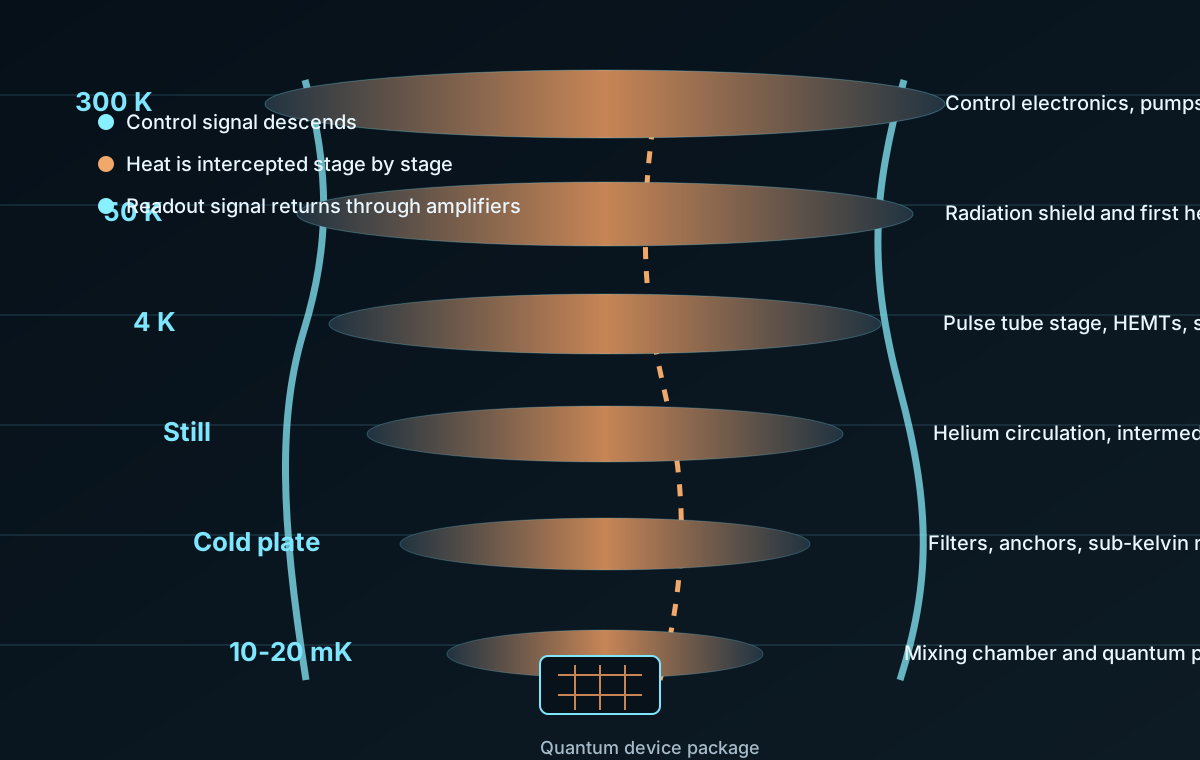
The mixing chamber is where the coldest useful part of many dilution refrigerators lives. In a superconducting quantum computer, the processor package often sits at or near this stage.
The advanced question is margin. The mixing chamber has limited cooling power, so cables, attenuators, filters, packages, radiation, and poor thermal contact can all decide whether the device truly operates where the thermometer says it should.
The mixing chamber is the coldest stage of a dilution refrigerator. In many superconducting quantum computers, the quantum processor package is mounted at or near this stage because it provides the millikelvin environment needed for low thermal excitation and stable microwave measurement.
The mixing chamber is precious real estate. It has limited cooling power, limited physical space, and high integration importance. Every final filter, isolator, cable anchor, chip package, sensor, and bracket competes for thermal and mechanical margin.
Why the mixing chamber matters
The dilution process produces cooling as helium-3 crosses the phase boundary into a helium-3/helium-4 mixture. The practical result is a cold plate where quantum devices, final filters, and sensitive readout components can be thermally anchored.
For superconducting systems, the mixing chamber is where thermal noise, package design, and microwave engineering meet. If the chip package is poorly thermalized, if too much RF power is dissipated nearby, or if too many components are mounted without margin, the device environment degrades.
Key specifications
| Specification | Why it matters |
|---|---|
| Base temperature | Shows unloaded low-temperature capability. |
| Cooling power at 20 mK and 100 mK | More useful for loaded systems and component planning. |
| Plate area and mounting pattern | Determines package, filter, and component layout. |
| Wiring access | Limits control, readout, pump, and sensor lines. |
| Thermal contact quality | Determines whether mounted components actually reach stage temperature. |
| Vibration environment | Can affect sensitive devices and measurement stability. |
Components often mounted nearby
- Quantum processor package.
- Final attenuators and filters.
- Isolators and circulators.
- Parametric amplifiers or TWPAs.
- Thermal anchors for final cable segments.
- Temperature sensors and heaters.
- Magnetic or radiation shielding.
Common mistakes
- Treating mixing-chamber cooling power as unlimited because the refrigerator reaches base temperature.
- Adding absorptive filters or attenuators without accounting for dissipated heat.
- Ignoring package-to-plate thermal contact.
- Routing cables in ways that create strain or block service access.
- Comparing mixing-chamber specifications without checking measurement conditions.
Related pages
- Dilution Refrigerator
- Cryogenic Thermal Budgeting
- Thermal Anchor
- The Quantum Computing Cooling Stack
What the diagram shows
Research sources
- Bluefors dilution refrigerator components: https://bluefors.com/stories/components-of-the-dilution-refrigerator-measurement-system/
- EPJ Quantum Technology, 100-qubit-scale setup: https://link.springer.com/article/10.1140/epjqt/s40507-019-0072-0
- IBM Goldeneye: https://www.ibm.com/quantum/blog/goldeneye-cryogenic-concept-system