Superconducting Qubits and Temperature
Superconducting qubits need cold because warmth looks like noise at microwave frequencies. If thermal energy is too high, the system is harder to initialize, control, and measure.
The advanced question is how cold is cold enough under real conditions: qubit frequency, thermal photons, line attenuation, filtering, shielding, package temperature, and loaded mixing-chamber margin all matter.
Superconducting qubits are engineered electrical circuits that behave quantum mechanically under carefully controlled conditions. Temperature is one of those conditions.
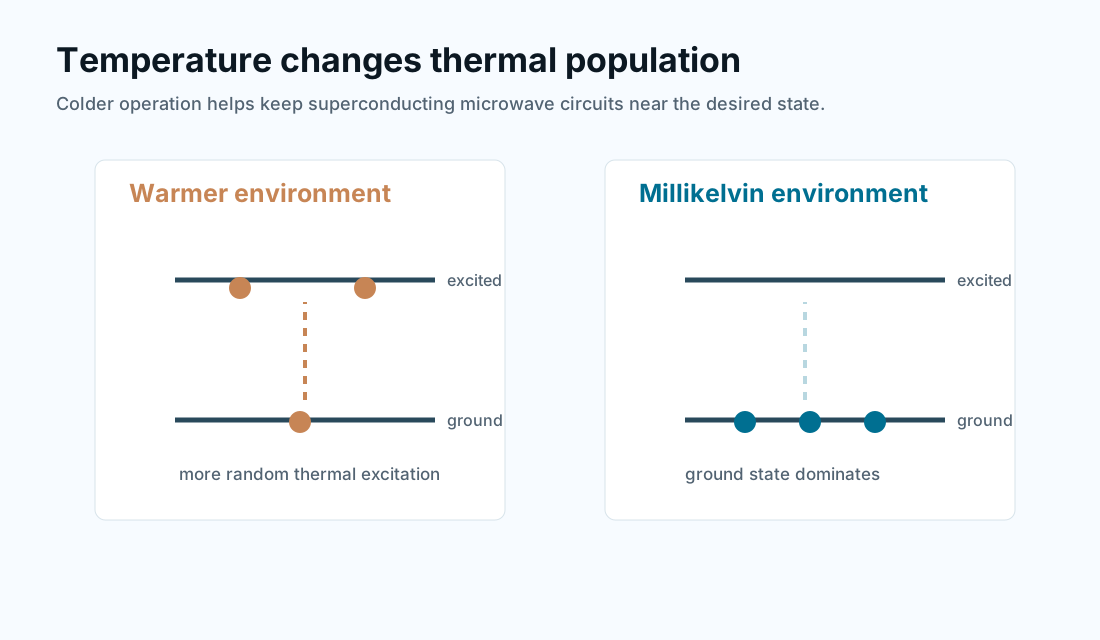
The key idea is simple: at warmer temperatures, thermal energy can randomly excite the circuit and disturb the quantum state. At millikelvin temperatures, the thermal population of microwave-frequency modes is reduced, making it possible to initialize, control, and read out qubits with higher fidelity.
Why not just cool to 4 K?
Four kelvin is extremely cold by everyday standards, but it is not always cold enough for today’s superconducting qubit architectures. Many systems use dilution refrigerators to reach the tens-of-millikelvin regime. Some research explores “hotter” qubits, cryogenic control electronics, and alternative architectures, but millikelvin operation remains central to much of the superconducting quantum computing ecosystem.
Temperature is not the only noise source
Colder is not automatically enough. Coherence and fidelity are affected by materials defects, dielectric loss, magnetic flux noise, quasiparticles, package modes, crosstalk, amplifier noise, radiation, and calibration. Cryogenics is necessary but not sufficient.
Common questions
Readers who land here often ask:
- How cold is a superconducting quantum computer?
- What temperature do superconducting qubits need?
- Why do quantum computers need dilution refrigerators?
- Are all quantum computers cold?
- What is decoherence?
What the diagram shows
Research sources
- NIST quantum refrigerator for superconducting qubit reset: https://www.nist.gov/news-events/news/2025/01/novel-quantum-refrigerator-great-erasing-quantum-computers-chalkboard
- NIST Quantum Characterization: https://www.nist.gov/programs-projects/quantum-characterization
- Oxford Instruments quantum measurement: https://www.oxinst.com/applications/quantum-measurement