Dilution Refrigerators for Quantum Computing
A dilution refrigerator is the machine that lets many quantum processors operate in the millikelvin regime. Think of it less as a cold box and more as a staged laboratory built inside a vacuum can.
The deeper story is about load and margin: helium circulation, pulse-tube cooling, stage temperatures, wiring, filters, amplifiers, vibration, and the difference between reaching base temperature empty and running a real quantum stack.
A dilution refrigerator is the workhorse cooling platform for many superconducting quantum computers. Its job is to create a stable millikelvin environment where a quantum chip, microwave resonators, filters, attenuators, and readout components can operate with low thermal noise.
Modern commercial systems from companies such as Bluefors and Oxford Instruments are often cryogen-free, meaning they use closed-cycle cooling and helium gas mixtures rather than requiring routine baths of liquid helium. These systems support the experimental infrastructure around superconducting qubits, spin qubits, quantum sensors, and low-temperature materials research.
How dilution refrigeration works
The core mechanism uses a mixture of helium-3 and helium-4. At very low temperatures, the mixture separates into two phases: a helium-3 rich phase and a helium-3 dilute phase. When helium-3 atoms cross the phase boundary into the dilute phase, the process absorbs heat. This cooling power is used at the mixing chamber, the coldest part of the refrigerator.
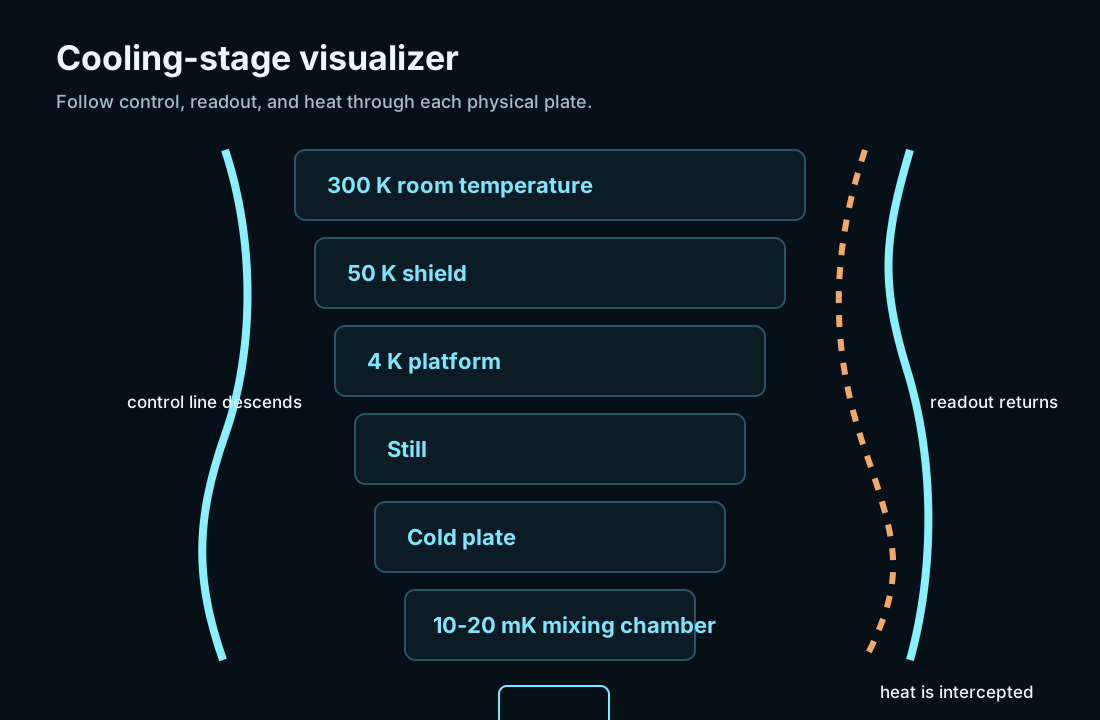
The refrigerator is staged. The names and roles of each stage are central vocabulary:
- Room temperature flange: mechanical and electrical interface to the outside world.
- 50 K stage: first major heat intercept.
- 4 K stage: pulse-tube cooled stage used for shields, amplifiers, and thermalization.
- Still: part of the helium circulation process, often around hundreds of millikelvin.
- Cold plate: a sub-kelvin thermal stage.
- Mixing chamber: the millikelvin endpoint where the processor package often sits.
What buyers and builders compare
Dilution refrigerators are not interchangeable boxes. Important comparison points include base temperature, cooling power at the mixing chamber, cooling power at 4 K, number of available wiring lines, mechanical footprint, vibration, cooldown time, sample access, magnet compatibility, software controls, gas-handling reliability, and service infrastructure.
For quantum computing, wiring capacity and thermal load matter as much as headline base temperature. A system that reaches a low base temperature with no experimental wiring may behave differently after dozens or hundreds of coaxial cables, DC lines, attenuators, filters, and amplifiers are installed.
Scaling problem
The dilution refrigerator is one of the places where quantum computing becomes an engineering discipline. More qubits need more signals, more readout paths, more shielding, and more calibration. Each additional line can introduce heat and noise. That is why cryogenic multiplexing, cryo-CMOS, improved packaging, and better thermal anchoring are active areas of development.
What the diagram shows
Internal links
Research sources
- Bluefors dilution refrigerator systems: https://bluefors.com/products/dilution-refrigerator-measurement-systems/
- Oxford Instruments principles of dilution refrigeration: https://nanoscience.oxinst.com/assets/uploads/NanoScience/Brochures/Principles%20of%20dilution%20refrigeration_Sept15.pdf
- Oxford Instruments quantum measurement: https://www.oxinst.com/applications/quantum-measurement
- Review of dilution refrigerator development: https://www.sciencedirect.com/science/article/pii/S001122752100148X