Quantum Cryogenics Glossary
Use the glossary when a term blocks the rest of the page. Quantum cryogenics borrows language from thermodynamics, microwave engineering, vacuum systems, low-temperature physics, and vendor catalogs, so unfamiliar words pile up fast.
For advanced readers, the glossary is most useful when it separates similar ideas: cryostat versus dilution refrigerator, base temperature versus loaded temperature, cable loss versus heat leak, and cooling power versus available margin.
This glossary defines the vocabulary technical readers need when moving between cryogenic engineering, quantum hardware, vendor catalogs, and research papers.
Core terms
Absolute zero: The theoretical lowest possible temperature, 0 K.
Attenuator: A component that reduces signal power, often used to reduce thermal noise on control lines.
Cold plate: A physical temperature stage used to mount and thermalize components.
Cryo-CMOS: CMOS electronics designed to operate at cryogenic temperatures near quantum hardware.
Cryocooler: A refrigerator designed to reach cryogenic temperatures.
Cryostat: An insulated environment used to maintain low temperatures for samples, detectors, or quantum devices.
Dilution refrigerator: A refrigerator that uses helium-3 and helium-4 dilution to reach millikelvin temperatures.
HEMT amplifier: A low-noise microwave amplifier used in cryogenic readout chains.
Kelvin: The absolute temperature scale used in cryogenics.
Millikelvin: One thousandth of a kelvin.
Mixing chamber: The coldest stage of a dilution refrigerator.
Pulse tube: A cryocooler often used in cryogen-free systems.
Qubit: A quantum bit; in superconducting systems, often a low-temperature microwave circuit.
SNSPD: Superconducting nanowire single-photon detector.
Thermal anchor: A structure that conducts heat from a wire or component into a temperature stage.
Thermal budget: The heat-load accounting for each cryogenic stage.
Thermal noise: Random electrical noise associated with temperature.
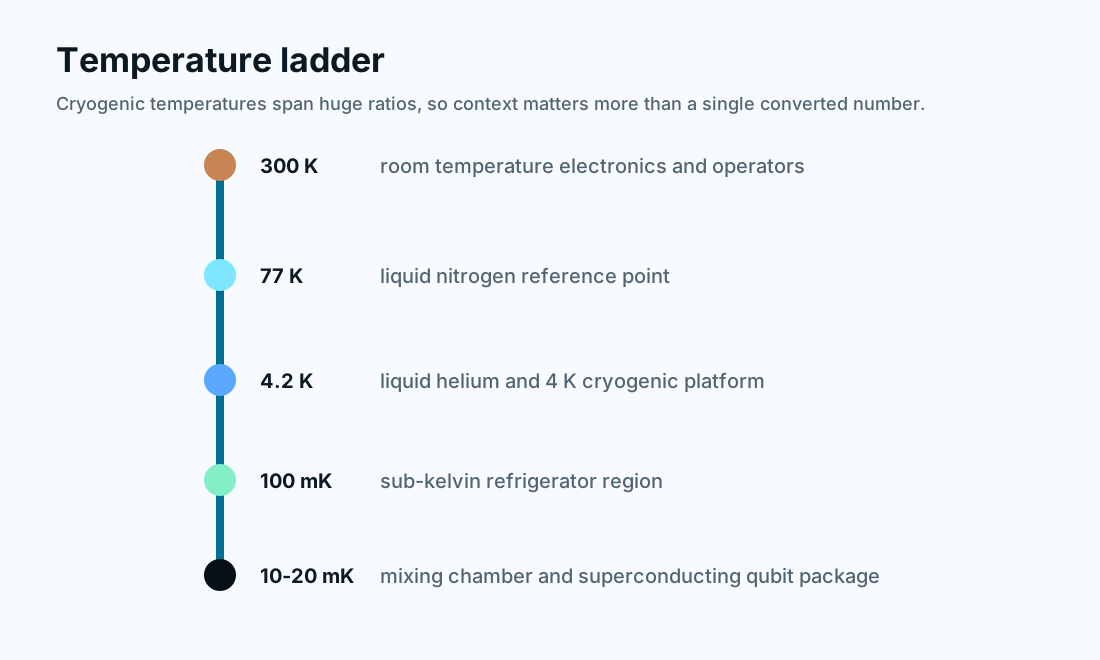
What the diagram shows
Research sources
- NIST cryogenics: https://trc.nist.gov/cryogenics/cryocoolers.html
- NIST single-photon detectors: https://www.nist.gov/pml/quantum-networks-nist/technologies-quantum-networks/single-photon-detectors
- Bluefors systems: https://bluefors.com/products/dilution-refrigerator-measurement-systems/